
Key Takeaways
- 76.5% of Hong Kong residents saw a doctor in the past 12 months, up from 58.8% in 2023. Outpatient demand is not a niche concern.
- Only 8.4% of the population was hospitalised, yet hospitalisation coverage is the most prevalent benefit at 92.6% of insured plans.
- 1 in 5 consultations in Hong Kong is TCM. It is a mainstream healthcare behaviour, not a supplementary add-on.
- Dental visits rose from 28.8% to 37.6% in two years. 15% of visits now cross the border to the GBA, driven by cost.
- Only 13.9% of insured plans include a medical check-up, while 34.4% of the population lives with a chronic condition.
- 67.5% of the 25 to 44 age group rely on medical insurance or an employer benefit. Your mid-career workforce is your highest-risk coverage gap.
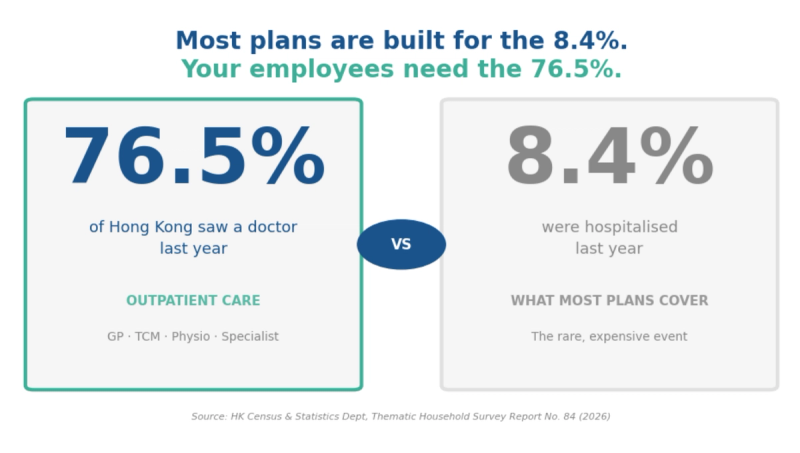
Most employee benefits plans in Hong Kong are engineered around a single event: a hospital stay. The problem is that only 8.4% of the population was actually hospitalised last year. Meanwhile, 76.5% saw a doctor for outpatient care, chronic condition management, allied health, or a combination of all three. The plan that sits in your employee handbook almost certainly reflects the first number, not the second.
That is not a design flaw from one employer. It is a structural pattern across the market, and the latest government survey data makes the mismatch measurable.
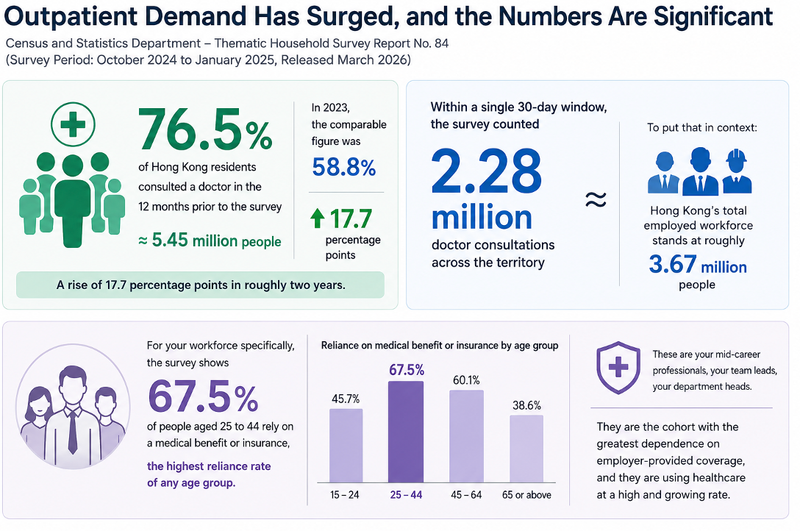
The Census and Statistics Department's Thematic Household Survey Report No. 84 (survey period: October 2024 to January 2025, released March 2026) puts the scale of outpatient demand into sharp relief.
76.5% of Hong Kong residents consulted a doctor in the 12 months prior to the survey, representing approximately 5.45 million people. In 2023, the comparable figure was 58.8%. That is a rise of 17.7 percentage points in roughly two years.
Within a single 30-day window, the survey counted 2.28 million doctor consultations across the territory. To put that in context: Hong Kong's total employed workforce stands at roughly 3.67 million people.
For your workforce specifically, the survey shows 67.5% of people aged 25 to 44 rely on a medical benefit or insurance, the highest reliance rate of any age group. These are your mid-career professionals, your team leads, your department heads. They are the cohort with the greatest dependence on employer-provided coverage, and they are using healthcare at a high and growing rate.
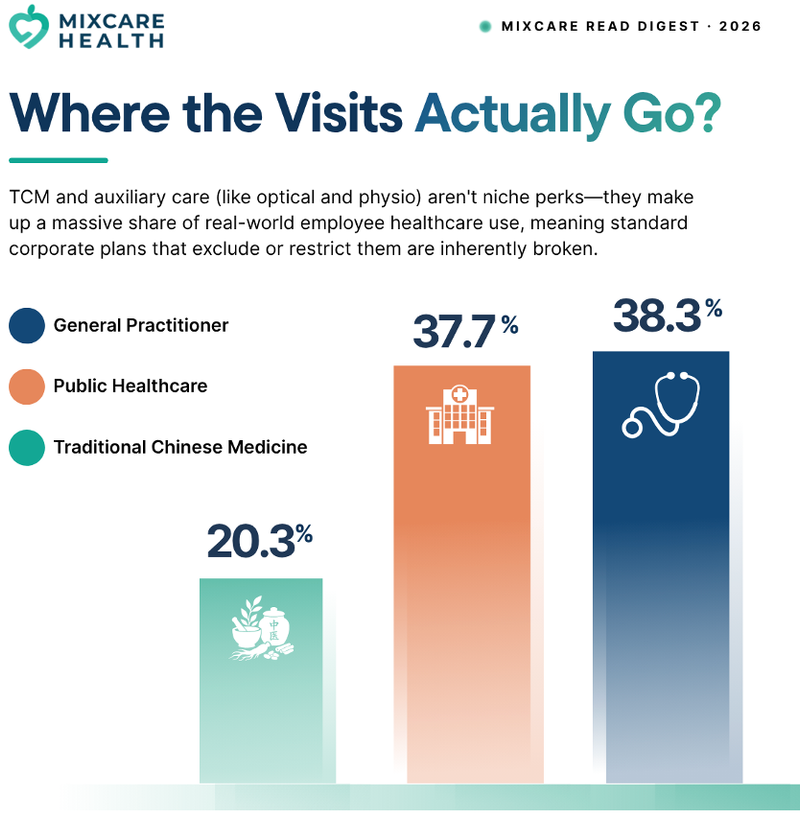
Understanding the volume is one thing. Understanding where people go for care matters equally for plan design.
Of all doctor consultations in the 30-day window, private Western GP visits accounted for 38.3% of the total. Public sector (Hospital Authority and Department of Health) Western consultations accounted for 37.7%. That split between private and public is broadly expected. What is worth examining is the third column: traditional Chinese medicine (TCM) accounted for 20.3% of all consultations.
One in five consultations is TCM. In Hong Kong, that is not a supplementary preference for a niche subset of employees. It reflects how a substantial portion of the population manages musculoskeletal issues, respiratory conditions, and chronic pain as a matter of routine. A plan that excludes or tokenises TCM coverage is not building for how employees actually use healthcare.
Beyond the three main practitioner types, 14.7% of people saw another healthcare professional in the same 30-day window. Of that group: optometrists accounted for 65.8%, physiotherapists for 30.9%, and chiropractors for 4.1%. Optical and physiotherapy claims are common, and both are typically under-covered or subject to low sub-limits in standard group plans.
The Coverage Gap: Highest Cover for the Rarest Event
The survey also asked what types of benefits insured individuals actually hold. The results illustrate an inversion that HR leaders should find uncomfortable.
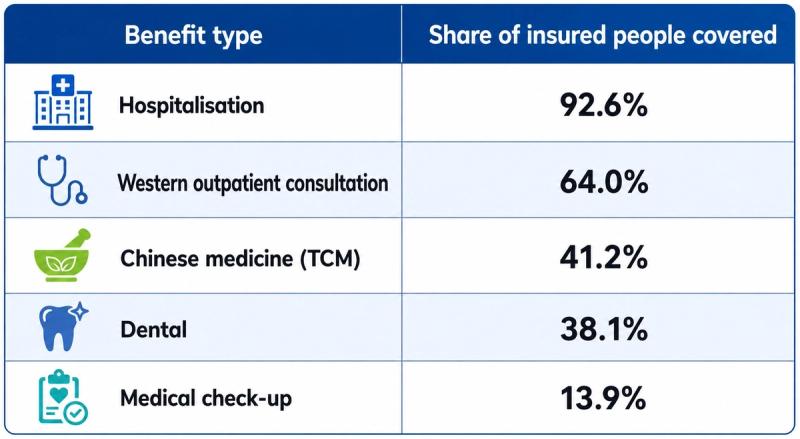
Coverage is highest (92.6%) for the benefit that 8.4% of people will ever use in a given year. Coverage is thinnest (13.9%) for medical check-ups, which are among the most direct tools for identifying chronic conditions early. Western outpatient, used by the majority of the workforce, is covered by only 64% of insured plans. TCM, which represents one in five consultations, is in fewer than half.
This is not coincidence. Legacy plan design followed insurance-industry product logic, which was built around catastrophic risk. The result is a benefits package where the everyday experience of your employees (booking a GP, seeing a TCM practitioner, filing a physio claim) is either uncovered or covered so minimally that the perceived value disappears.
Consider the population-level exposure beyond your organisation: 49% of Hong Kong residents have no employer benefit and no individual insurance at all. Of those who are insured, 30.6% rely exclusively on an employer benefit. What you provide is, in many cases, the entirety of your employees' financial protection against healthcare costs.
Dental and Preventive Care: The Second Gap
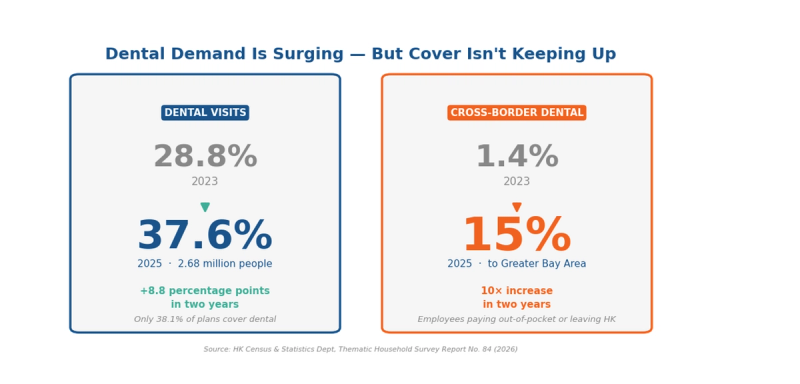
Dental data from the same survey tells a similar story.
37.6% of Hong Kong residents visited a dentist in the 12 months prior to the survey, approximately 2.68 million people. In 2023, the equivalent figure was 28.8%. Dental visits have increased by nearly nine percentage points in two years.
The cross-border dimension is striking. 15% of dental visits now involve travel to the Greater Bay Area (GBA), up from just 1.4% in 2023. The primary driver is cost: dental treatment in Shenzhen and other GBA cities is materially cheaper than private dental care in Hong Kong. When employees leave the territory for routine dental work, it is a clear signal that local coverage has not kept pace with demand.
Preventive care follows the same pattern. Only 13.9% of insured plans include a medical check-up. Given that 34.4% of the population now lives with a chronic condition (up from 31.2%), and that chronic conditions affect 78% of those aged 65 and older, the case for preventive screening as a standard benefit component has never been stronger. Earlier detection reduces severity, reduces lost working days, and (in actuarial terms) reduces long-term claims costs.
What This Means for HR Teams
Three practical conclusions follow from this data.
The benefit your employees feel is the benefit they use every week. A hospitalisation policy is essential, but it is invisible to the majority of your workforce for most of the year. The GP consultation, the TCM visit, the physio appointment, the dental check: these are the touchpoints that shape how employees experience your total compensation package. A plan that leaves those touchpoints uncovered or undervalued will not score well in a benefits satisfaction survey, regardless of what the hospitalisation ceiling looks like.
Your core talent cohort is the most reliant on you. The 25 to 44 age band shows the highest insurance reliance (67.5%) and a consultation rate of 68.7%. This group is also the demographic most likely to be evaluating career moves and comparing total compensation across employers. A benefits package that does not reflect their actual healthcare behaviour is a gap that will surface in exit interviews and offer negotiations.
Coverage gaps carrya real cost to perceived compensation value. When employees pay out of pocket for outpatient, dental, or TCM care that a comprehensive plan would cover, the effective value of their total compensation falls, even if the nominal salary stays the same. That out-of-pocket spend is a direct transfer from your employee to the healthcare system, unmediated by the benefit you are already funding. For HR teams tracking benefits ROI, theutilisation gap between what employees need and what the plan covers is the number that matters.
See Where Your Plan Stands
The data points above are territory-wide averages. The gap inside your own organisation will depend on workforce demographics, plan structure, and how you currently track utilisation.
MixCare Health works with HR teams across Hong Kong to map that gap and redesign benefits around what employees actually use. The platform is modular, APAC-native, and built to cover the full spectrum of care your workforce needs: outpatient, TCM, dental, allied health, and preventive.
Book a 20-minute walkthrough here to see the data from your own plan alongside Hong Kong benchmarks. No commitment required.
Source: Census and Statistics Department, Hong Kong SAR. Thematic Household Survey Report No. 84. Survey period: October 2024 to January 2025. Released: 19 March 2026.
MixCare Health
MixCare Health · Hong Kong