
A strong employee benefits strategy in Hong Kong goes beyond offering more perks. Learn how employers can align benefits with workforce needs, business objectives and budgets while creating a competitive employee experience that supports attraction, retention and engagement.
Key Takeaways
A strong employee benefits strategy Hong Kong enterprises can use should connect legal compliance, employee priorities, and financial discipline. The most effective plans are reviewed regularly rather than treated as a one-time HR exercise.
- Start with clear business and workforce objectives.
- Separate statutory obligations from optional benefits.
- Use employee data to guide plan design.
- Balance competitive benefits with sustainable costs.
- Measure usage, fairness, and talent outcomes over time.
1. Define the goals of your employee benefits strategy
A benefits strategy should support the direction of the business, not sit apart from it. Before selecting policies or providers, decide what the programme needs to achieve for the organisation and its people. This makes later decisions easier to explain, fund, and measure.
a. Align benefits with business growth plans
Benefits should reflect the company’s growth stage, hiring plans, and operating model. A business opening a new office may need benefits that support recruitment across borders, while a scaling local employer may first need a consistent and manageable foundation. Tie benefit decisions to workforce numbers, locations, role requirements, and the pace of expansion.
b. Address attraction, retention, and engagement challenges
Different talent problems call for different responses. If candidates are declining offers, the issue may be limited healthcare support or an unclear total reward proposition; if experienced employees are leaving, flexibility, career development, or family support may matter more. Treat benefits as one part of the employee experience, and connect each proposed improvement to a clearly observed challenge.
c. Identify workforce segments and employee priorities
A single package rarely serves every employee equally well. Consider job family, seniority, age, family responsibilities, work location, and whether people are local or internationally mobile. Segmenting the workforce does not require a separate plan for everyone; it helps determine where choice, targeted allowances, or different communication are most useful.
d. Set measurable benefits objectives and KPIs
Translate broad aims into measures that can be reviewed. Useful indicators include enrollment, utilization, employee satisfaction, time to administer claims, offer acceptance, and voluntary turnover. Clear measures improve decisions because they show whether a benefit is solving a real problem or simply increasing programme complexity.
2. Understand Hong Kong’s statutory benefits requirements
Hong Kong employers need a reliable baseline for statutory entitlements before adding voluntary perks. The Employment Ordinance and Mandatory Provident Fund requirements affect leave, rest days, retirement contributions, and employee protection. Requirements can vary with employment status and individual circumstances, so organisations should confirm current obligations with qualified local advisers and official sources.

a. Provide statutory holidays, leave, and rest days
Employers should maintain accurate records for statutory holidays, rest days, annual leave, sickness absence, maternity leave, and paternity leave where applicable. Entitlements may depend on factors such as length of service and the type of employment contract. A clear policy, consistent recordkeeping, and an escalation route for questions reduce avoidable disputes.
b. Manage Mandatory Provident Fund obligations
Eligible employees and employers generally have MPF contribution responsibilities, subject to the applicable rules, income limits, and exemptions. Payroll teams must calculate, deduct, contribute, and remit amounts correctly and on time. Because MPF administration is both financial and regulatory, it should be reconciled routinely rather than checked only during an annual review.
c. Follow employee compensation and protection requirements
Benefits planning should also account for employment-related protection, including statutory sick leave arrangements, termination-related obligations, and employees’ compensation requirements. The exact treatment depends on the facts of each case. Keep the statutory baseline separate from discretionary enhancements so managers do not accidentally describe an optional benefit as a legal entitlement.
d. Distinguish statutory benefits from voluntary perks
A benefits guide should label each item plainly: statutory, contractual, or discretionary. This distinction helps employees understand what is guaranteed and helps finance teams forecast the cost of enhancements. For a broader starting point, employers can review this Hong Kong benefits compliance guide before building a local checklist.
e. Monitor regulatory updates and compliance risks
Assign responsibility for monitoring changes and document when policies were reviewed. Payroll, HR, finance, and external advisers should know who approves updates and who communicates them to employees. A short quarterly compliance review is often more practical than allowing small changes to accumulate unnoticed.
3. Assess employee needs across your workforce
Employee preferences are useful only when gathered systematically. Combine what people say they value with what they actually use, then compare those findings with business constraints. This approach avoids designing an expensive package around a small number of loud requests.
a. Use surveys, interviews, and utilization data
Use a short annual survey for broad sentiment, supplemented by interviews or focus groups for context. Claims, enrollment, reimbursement, and event participation data can reveal barriers that employees may not mention directly. Ask about awareness and ease of access as well as preference; a low-use benefit may be poorly communicated rather than irrelevant.
b. Compare priorities by age, role, and life stage
A younger employee may place more value on fitness, mental wellness, or professional development, while an employee with dependants may prioritize medical coverage and family support. These are tendencies, not assumptions. Compare results across groups without using demographic categories to limit access or create unfair treatment.
c. Account for local and international employees
Hong Kong teams may include local hires, relocated employees, and people supporting regional operations. Their expectations around medical access, dependants, language, and portability can differ. Review whether eligibility, provider networks, reimbursement rules, and communications work for each group, especially when employees move between locations.
d. Balance employee preferences with business practicality
Not every popular request belongs in the core package. Assess cost, administrative effort, legal treatment, provider availability, and likely participation before committing. A menu of employer-defined choices can sometimes provide more value than adding many low-use benefits to a fixed plan.
4. Build a competitive benefits package
A competitive package combines dependable essentials with meaningful choice. Healthcare may be the foundation, but employees also look at flexibility, financial security, family support, and everyday wellbeing. The right mix depends on workforce needs and budget rather than on copying another employer.

a. Combine healthcare, insurance, and wellness support
Start by mapping the full care journey: routine outpatient needs, protection against major events, preventive support, and mental wellbeing. Review exclusions, provider access, claims experience, and the communication employees receive. MixCare Health provides a configurable ecosystem that includes self-funded outpatient care, flexible spending, wellness services, and events, so employers can consider modular choices rather than a single fixed design.
b. Structure retirement and financial wellness benefits
MPF is the statutory foundation, but employees may also value education about saving, budgeting, and long-term financial planning. Explain contribution rules and any employer enhancements in plain language. Financial wellness support should complement, not obscure, the core retirement obligations.
c. Consider flexible work and family-friendly policies
Flexible working arrangements, caregiving support, parental policies, and leave practices can influence whether employees can remain productive during changes in family life. Set clear eligibility and manager guidance so flexibility is applied consistently. Benefits are more credible when employees understand how to use them without negotiating individually each time.
d. Evaluate allowances, bonuses, and lifestyle perks
Cash allowances and bonuses can be useful when tied to a clear purpose, such as transport, learning, or performance. Lifestyle benefits may add value when they are easy to access and relevant to a broad share of the workforce. Review tax, payroll, and documentation implications before announcing a new allowance.
e. Benchmark benefits against Hong Kong employers
Benchmarking can reveal whether the package is competitive, but external data should be treated as a reference rather than a specification. Compare benefit levels, eligibility, employee contributions, utilization, and communication quality. A current Hong Kong benefits and perks report can provide useful context for questions to test against your own workforce data.
5. Create a sustainable benefits budget
Cost control should begin during design, not after a renewal increase or an unexpectedly high claim bill. Build a multi-year view that includes employer contributions, vendor fees, payroll work, communication, and the cost of employee time. A lower headline price is not necessarily cheaper if it creates heavy administration or poor usage.
a. Calculate direct and indirect benefits costs
Direct costs include premiums, employer-funded allowances, contributions, and provider charges. Indirect costs include HR administration, payroll changes, employee support, implementation, and time spent resolving claims or eligibility questions. Estimate both categories for each option so leaders can compare total cost rather than only the invoice.
b. Prioritize high-value benefits for critical roles
Some benefits may be especially relevant to scarce skills, senior roles, or locations where hiring is difficult. That does not mean creating arbitrary inequalities. Define the business rationale, document eligibility, and check that the overall package remains fair and understandable across the workforce.
c. Compare insured, reimbursed, and flexible approaches
Insured plans can provide predictability for certain risks, while reimbursement models may suit narrower or more controllable categories. Flexible wallets can give employees choice within employer-defined limits. Compare administration, utilization, employee experience, claims exposure, and compliance before selecting a structure.
d. Model costs for different workforce scenarios
Create scenarios for headcount growth, higher utilization, changing age mix, new locations, and different employee contribution levels. A simple sensitivity model can show which assumptions most affect the budget. Revisit those assumptions before renewal rather than relying on the previous year’s numbers.
e. Review tax, payroll, and administrative implications
Ask finance and payroll to review how each benefit is treated, recorded, and reported. Confirm whether allowances require supporting documents and whether provider data can be reconciled with payroll. These checks reduce surprises and clarify the work required from HR before launch.
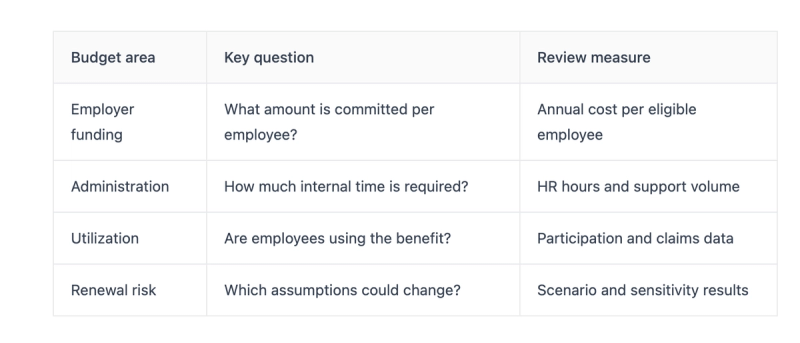
This simple view encourages decision-makers to consider value and workload together. It also gives finance and HR a shared language for discussing adjustments.
6. Design an effective benefits implementation plan
A thoughtful design can still fail if employees cannot understand or access it. Plan the rollout as an operational change, with owners, deadlines, testing, and support. Employees should know what is available, who qualifies, how to enroll, and where to ask for help.
a. Assign ownership across HR, finance, and leadership
Name one accountable owner and define responsibilities for HR, finance, payroll, legal, IT, managers, and senior leadership. Decide who approves plan changes, who handles exceptions, and who receives monthly reporting. Clear ownership prevents employees from being passed between teams when a question crosses functional boundaries.
b. Select suitable providers and technology platforms
Evaluate providers against network access, configuration, reporting, service responsiveness, integration, data protection, and total cost. Ask to see the employee journey as well as the administrator workflow. MixCare Health offers configurable benefits capabilities for employers, including flexible spending and a wellness marketplace, which may be relevant when a company wants choice within a managed platform.
c. Communicate benefits clearly to employees
Use plain-language summaries, comparison tables, onboarding materials, and manager briefings. Explain examples without implying that every employee will have the same eligibility or reimbursement outcome. Communication should happen before enrollment, during the decision window, and after launch when common questions emerge.
d. Support enrollment, claims, and policy changes
Set a defined enrollment period and provide reminders through channels employees already use. Test claims, eligibility changes, payroll deductions, and employee data updates before launch. After implementation, publish response times and escalation routes so employees know what support looks like.
e. Protect employee data and maintain documentation
Limit access to personal and health information, document retention rules, and review vendor security controls. Maintain current plan documents, eligibility rules, approvals, and employee communications. Data protection is part of benefits quality because employees need confidence that sensitive information is handled responsibly.
7. Measure and improve benefits performance
Benefits should be managed as a continuing programme. Review utilization and employee feedback alongside recruitment, retention, cost, and service data. A regular review also helps identify benefits that look attractive on paper but are difficult to access in practice.
a. Track participation, utilization, and employee feedback
Monitor enrollment, claims or reimbursement patterns, wallet spending, event attendance, support requests, and satisfaction. Segment the results by location, role, and eligibility group where appropriate. Pair quantitative data with employee comments so the team can distinguish low demand from low awareness or poor usability.
b. Evaluate recruitment and retention outcomes
Ask whether benefits appear in candidate questions, offer discussions, onboarding feedback, and exit interviews. Compare outcomes with the relevant talent population rather than claiming that one benefit caused a change. Benefits are one factor among compensation, management, workload, career opportunity, and culture.
c. Monitor equity across employee groups
Check whether employees with different work patterns, locations, or family situations can access comparable value. Look for differences in awareness, enrollment, provider access, and approval rates. Where gaps appear, adjust design or communication without exposing individual health information.
d. Review provider performance and service quality
Use agreed service levels for response times, claims handling, reporting, issue resolution, and data accuracy. Hold regular provider reviews and record corrective actions. Employee feedback is especially valuable when it reveals friction that summary utilization figures cannot show.
e. Refresh the strategy as workforce needs change
Set an annual strategy review and shorter operational checkpoints. Reassess headcount, business priorities, regulation, health trends, utilization, and employee expectations. The strongest programme is not the one with the most features; it is the one that remains relevant, understandable, and financially workable.
Conclusion
An effective Hong Kong benefits strategy starts with statutory discipline, adds benefits employees genuinely value, and uses evidence to guide every major decision. By connecting workforce needs with budget, communication, compliance, and ongoing measurement, enterprises can create a package that supports both employee wellbeing and sustainable growth.
Frequently Asked Questions
What are the main statutory employee benefits in Hong Kong?
They generally include statutory holidays, rest days, annual leave, eligible sickness and family-related leave, MPF obligations, and applicable employee protection requirements. Exact entitlements depend on employment status, service length, and current law.
How can an employer make benefits more attractive without overspending?
Start by identifying the benefits employees use and value most, then remove low-value complexity. Flexible choices, clear communication, and targeted support can improve perceived value without adding every possible perk.
Should every employee receive exactly the same benefits?
A common core can support fairness, while carefully designed choices may address different roles, locations, and life stages. Any variation should have a clear business rationale and be communicated transparently.
How often should a Hong Kong benefits strategy be reviewed?
Review operational data throughout the year and conduct a fuller strategy review at least annually. Revisit the plan sooner when regulations, workforce composition, provider performance, or business priorities change.
What data should employers use to evaluate benefits?
Useful data includes enrollment, utilization, claims or reimbursement activity, employee feedback, support requests, provider service levels, recruitment indicators, and voluntary turnover. Use aggregated information and protect personal data.
Are wellness benefits worth including in an employee package?
They can be valuable when they match employee needs, are easy to access, and have clear participation or wellbeing objectives. Employers should assess relevance and usage rather than assuming that every wellness activity will be effective.
Who should own the benefits strategy?
HR or total rewards may coordinate the programme, but finance, payroll, legal, IT, leadership, and managers all have important responsibilities. One accountable owner should coordinate decisions and maintain the implementation roadmap.
MixCare Health
MixCare Health · Hong Kong