
Financial wellness benefits for Hong Kong employees can go beyond salary and MPF. Discover how employers can support budgeting, debt management, retirement planning, healthcare costs, and financial confidence while building a stronger, more resilient workforce.
Key Takeaways
Financial wellness is broader than pay: it helps employees manage everyday pressures while preparing for future needs. A thoughtful Hong Kong program can support both people and business performance.
- Financial support should address cash flow, debt, emergencies, and retirement together.
- Hong Kong programs need to reflect MPF, housing costs, healthcare, and family responsibilities.
- Confidential education and guidance make it easier for employees to ask for help.
- Employers should offer accessible resources in the languages employees use most comfortably.
- Participation, confidence, stress, and workforce outcomes can guide continuous improvement.
1. Understanding financial wellness in the Hong Kong workplace
Financial wellness describes an employee’s ability to meet current obligations, make informed choices, and work toward longer-term goals. It is not simply a higher salary or a larger benefits package. For employers, the practical question is whether people can understand and use the support available to them. The strongest programs connect financial education with relevant workplace benefits and clear, respectful communication.
a. What financial wellness means beyond salary and benefits
Salary remains central, but financial well-being also depends on confidence, resilience, and access to useful choices. An employee may earn a competitive income and still feel uncertain about debt, insurance, retirement, or an unexpected medical bill. A good program helps people understand their options without assuming that every employee has the same priorities. That makes financial wellness a people experience issue as much as a compensation issue.
The aim is not to tell employees how to spend their money. It is to provide practical information, decision support, and benefits that fit different circumstances. Small, usable steps such as reviewing cash flow or building an emergency reserve can make longer-term planning feel more manageable.
b. The financial pressures affecting Hong Kong employees
Hong Kong employees may be balancing high housing costs, family support, healthcare expenses, education costs, and retirement planning at the same time. MPF contributions provide an important retirement foundation, but employees still need to understand how their wider savings and protection decisions fit together. Financial pressure can also vary sharply between early-career workers, parents, caregivers, and employees approaching retirement.
Employers should therefore avoid designing support around one assumed employee profile. Listening exercises and anonymous surveys can reveal whether people want help with budgeting, debt, emergency savings, protection, or retirement. The Hong Kong financial wellness guide offers additional context on how financial stress can affect concentration, productivity, and attendance.
c. How financial stress influences work and personal life
Money worries rarely stay neatly outside the workplace. An employee who is preoccupied with bills or a family financial decision may find it harder to concentrate, make decisions, or recover after work. Persistent uncertainty can also affect sleep, relationships, and willingness to ask for support.
This does not mean employers should monitor private finances or promise to solve every financial challenge. It means they can create a trusted route to education and assistance. Clear confidentiality safeguards, neutral language, and flexible access help employees seek support before a short-term concern becomes a wider personal or workplace problem.
2. The key financial wellness benefits for Hong Kong employees
The value of financial wellness benefits is most visible when employees can use them at the moment a need arises. Education may help someone plan, while a well-designed benefit can reduce friction around healthcare or everyday wellbeing spending. Employers should present these options as part of a broader support system, not as a substitute for fair pay or responsible employment practices.

a. Reduced financial stress and improved mental well-being
A program can reduce uncertainty by helping employees understand where to start and whom to ask. Budgeting resources, debt education, emergency savings guidance, and access to appropriate professional support can give people a clearer next step. The benefit is not a guarantee that stress disappears; rather, employees gain tools to respond more deliberately.
Communication matters just as much as the resource itself. Employees should be able to explore support privately, without feeling that financial difficulty will affect how managers view them. This is particularly important for sensitive concerns involving debt, family obligations, or health-related costs.
b. Greater productivity, engagement, and job satisfaction
Financial distraction can compete with attention at work. When employees understand their benefits and feel that the organization recognizes real-life pressures, they may be better positioned to focus on their roles and participate in workplace life. These outcomes should be measured carefully rather than assumed.
A useful program also improves the employee experience around benefits administration. Clear eligibility rules, simple claims or spending processes, and timely answers reduce avoidable frustration. Employers can connect financial wellness with employee wellbeing resources while keeping the program focused on practical, financial needs.
c. Stronger confidence in everyday money decisions
Confidence grows when information is understandable and relevant. Short learning sessions can cover cash flow, debt repayment, insurance basics, investment risk, and the relationship between present choices and future goals. Employees do not need to become financial experts; they need enough clarity to make decisions appropriate to their circumstances.
Employers should avoid overwhelming people with jargon or a long catalogue of disconnected resources. A staged learning journey works better: start with immediate money questions, then introduce protection and retirement topics as employees are ready.
d. Better preparedness for emergencies and retirement
Financial wellness benefits can help employees prepare for both the foreseeable and the unexpected. Emergency savings guidance, protection education, and retirement planning each address a different part of resilience. Together, they can help employees think beyond the next pay cycle while still respecting current pressures.
The design should make progress visible without exposing personal balances to the employer. General calculators, workshops, and confidential guidance can support planning, while employees retain control over their own financial information.
3. How financial wellness programs support employees
Programs work best when they combine learning, guidance, and easy access to relevant workplace benefits. A single annual seminar is unlikely to meet the needs of a diverse workforce. Instead, employers can create several entry points, from short digital lessons to private conversations and clear benefit tools.
The program should also explain what it does not provide. Financial education is not personal legal or tax advice, and employees may need qualified professionals for decisions with significant consequences. Clear boundaries build trust rather than weakening the offer.
a. Financial education for budgeting, saving, and debt management
Education should begin with skills employees can apply quickly. Budgeting content can explain cash flow and spending priorities, while saving modules can address emergency reserves and short-term goals. Debt education should cover repayment approaches, interest, and the importance of seeking help before obligations become unmanageable.
A practical curriculum might include short videos, workshops, examples, and optional exercises. Repetition is useful: employees often need to encounter a concept more than once before it becomes part of their routine.
b. Access to professional guidance and personalized planning
Some questions cannot be answered by a general article. Employees may need help thinking through retirement contributions, insurance needs, family responsibilities, or a major financial change. Confidential coaching or referrals to qualified advisers can add the personal context that generic content lacks.
Access should not be limited to senior staff or employees who already feel confident. Offering appointments at different times, with clear privacy explanations, makes guidance more equitable. The financial coaching and education approach illustrates why jargon-free support and personalized coaching can sit alongside digital learning.
c. Workplace tools for pensions, insurance, and investments
Digital tools can turn abstract planning into a sequence of manageable decisions. Employees might use a retirement projection, review benefit choices, or learn how risk and time horizon affect investment decisions. Tools should explain assumptions plainly and remind users that illustrations are not guarantees.
For employers, the administration experience matters too. A coherent benefits interface can make it easier to communicate eligibility, deadlines, and available support. Where a program includes healthcare or wellness spending, the same clarity should apply to approved categories and access rules.
d. Confidential support for different financial life stages
A graduate entering the workforce may need budgeting and debt guidance, while a parent may prioritize protection and healthcare costs. An employee supporting older relatives may have different concerns again. Financial wellness programs should acknowledge these stages without labeling employees or requiring them to disclose personal circumstances publicly.
A flexible program can offer a core set of resources alongside optional pathways. That approach gives employees room to choose what is relevant, and it helps employers avoid spending heavily on benefits that few people understand or use.
4. Designing a program for Hong Kong employees
Design begins with local context and employee choice. Hong Kong teams may include Cantonese-speaking employees, English-speaking professionals, expatriates, shift workers, caregivers, and people with very different levels of financial knowledge. A program should be easy to navigate while remaining careful about privacy, compliance, and the limits of employer involvement.
A modular benefits ecosystem can help employers adjust support without forcing every employee into the same package. For example, MixCare Health provides configurable employee benefit programs designed for organizations across Asia-Pacific, with analytics, compliance, and HR integration described in its enterprise benefits platform. The relevant capability should be matched to the need rather than added simply because it is available.

a. Addressing MPF contributions and retirement planning
Retirement education should explain MPF in the context of a wider personal plan. Employees may need help understanding contribution arrangements, investment choices, fees, risk, and how retirement timing affects their goals. Employers can provide neutral educational materials and invite qualified experts to explain complex topics.
Retirement should not be presented as an urgent concern only for older employees. Early-career workers benefit from understanding the value of time, while mid-career employees may need to review changing family responsibilities and savings priorities.
b. Supporting housing costs, healthcare, and family obligations
Housing and family commitments can shape an employee’s financial decisions more than any single workplace benefit. Healthcare expenses may also arrive unexpectedly, making clear information about coverage, exclusions, and spending support especially valuable. Employees should be able to see how benefits fit alongside their existing responsibilities.
Employers can use listening sessions to identify practical gaps, then prioritize resources that address the most common needs. This could include healthcare spending support, financial education, caregiver resources, or referrals to professional guidance, depending on the workforce and budget.
c. Providing Cantonese, English, and culturally relevant resources
Language affects whether employees understand and trust a program. Offering key materials in Cantonese and English, using plain explanations, and avoiding assumptions about family finances can improve access. Translation should cover not only launch announcements but also instructions, privacy notices, and help channels.
Cultural relevance also means recognizing that employees may support relatives or make financial decisions as part of a wider household. Examples should reflect those realities without stereotyping. Feedback from employees can show whether the tone and format feel respectful.
d. Balancing digital tools with human financial guidance
Digital access is convenient, particularly for employees working different schedules or locations. Yet a tool cannot always answer an emotionally difficult or highly personal question. A balanced program offers self-service content for simple needs and human guidance for situations that require context.
The right mix can be tested through a phased rollout. Employers might begin with a small library and scheduled sessions, then add tools based on actual usage. This approach keeps the experience manageable and gives HR evidence for future investment.
5. Measuring the business impact of financial wellness benefits
Measurement should connect employee experience with responsible business questions. Employers want to know whether people can find and use support, whether confidence improves, and whether the program contributes to a healthier workplace. No single metric can prove causation, so a balanced scorecard is more credible than a headline number.
Set a baseline before launch where possible. Compare participation and survey responses over time, while allowing for broader economic conditions, organizational changes, and differences between employee groups.
a. Employee participation and engagement metrics
Start with practical measures: registrations, attendance, content completion, appointments, benefit usage, and repeat engagement. Break results down by location, role, language, or employment stage only when the groups are large enough to protect privacy. Low participation may signal poor timing, confusing communication, or a resource that does not match employee needs.
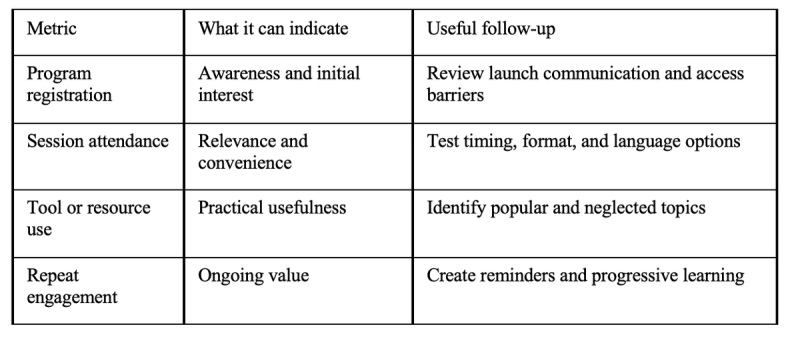
These measures show activity, not necessarily impact. They become more meaningful when paired with employee feedback and evidence that people can apply what they learn.
b. Changes in financial confidence and stress levels
Anonymous pulse surveys can ask whether employees feel more confident managing cash flow, understanding benefits, or planning for future needs. Use consistent questions before and after key interventions, but keep surveys short enough to encourage honest participation. A change in reported confidence is useful evidence, though it should not be treated as a clinical measure of mental health.
Qualitative comments can explain the numbers. Employees may describe a confusing process, a helpful workshop, or a topic that needs deeper support. Those observations often point to improvements that usage data alone cannot reveal.
c. Productivity, absenteeism, and retention indicators
Employers may examine broad workforce indicators such as absence patterns, engagement results, and retention, while recognizing that financial wellness is only one possible influence. Comparisons should be cautious and appropriately aggregated. A program should never be marketed as a guaranteed productivity or retention solution.
It can still be useful to look for directional changes alongside employee feedback. If results are mixed, the answer may be to improve program relevance rather than to abandon financial wellness altogether.
d. Using surveys while protecting employee privacy
Privacy must be designed into measurement from the start. Collect only what is needed, explain how responses will be used, and report results in groups large enough to prevent re-identification. Personal balances, debt details, and individual advice should remain outside routine employer reporting.
Employers should also review data handling, access permissions, retention periods, and vendor responsibilities. Trust in the measurement process is part of trust in the benefit itself.
6. Implementing a sustainable financial wellness strategy
A sustainable strategy is built in stages. Begin with listening, define a small number of outcomes, and give employees repeated opportunities to engage. Then review what worked and adjust the content, channels, and benefit mix rather than treating launch day as the finish line.
The employer’s role is to make support accessible and credible. It is not to judge personal financial choices or pressure employees to disclose sensitive information. That distinction should guide every communication and manager interaction.
a. Assessing employee needs before selecting solutions
Use a combination of anonymous surveys, focus groups, existing benefits questions, and workforce data that is already collected responsibly. Ask employees what financial questions occupy their attention, which formats they prefer, and what prevents them from using current benefits. Include frontline and lower-access workers, not just office-based employees.
Translate findings into priorities. If employees mainly need help understanding healthcare spending, a retirement-heavy launch may miss the moment. If retirement anxiety is widespread, education and guidance should appear early rather than being buried in a general wellbeing library.
b. Setting a realistic budget and rollout timeline
A practical budget covers content, guidance, technology, communications, administration, and evaluation. It should also allow for iteration. A smaller pilot with clear learning goals can be more useful than a broad launch that employees find difficult to navigate.
Set milestones for discovery, design, communication, launch, and review. Assign ownership across HR, finance, benefits, legal, and privacy teams so that the program has operational support as well as a polished front end.
c. Training managers to promote resources appropriately
Managers are often the first people employees approach, but they should not become informal financial advisers. Training should show them how to signpost available resources, protect confidentiality, and respond without judgment. Managers also need clear guidance on what they must escalate and what should remain private.
Short scripts and manager toolkits can make communication consistent. For example, a manager can share a support channel after a benefits announcement without asking why an employee is interested or whether they have personal financial difficulties.
d. Reviewing outcomes and improving the program over time
Review participation, survey trends, employee comments, and operational feedback on a regular cycle. Remove content that is not used, improve resources that cause confusion, and add support when a new need emerges. A program earns credibility when employees can see that feedback leads to visible changes.
The long-term measure is not how many features an employer launches. It is whether employees can find relevant help, understand their choices, and use benefits with less friction. That is the practical foundation of financial wellness benefits Hong Kong employees can trust.
Conclusion
Financial wellness becomes meaningful when it reflects the real financial decisions Hong Kong employees face and gives them practical, private ways to act. Employers can build stronger support by combining education, guidance, locally relevant benefits, careful measurement, and steady improvement. The result is a more useful employee experience and a workplace better equipped to respond to changing needs.
Frequently Asked Questions
What are financial wellness benefits for employees?
They are workplace resources that help employees manage everyday money, prepare for emergencies and retirement, understand benefits, and make informed financial decisions. They may include education, coaching, planning tools, and relevant spending or protection benefits.
Why do Hong Kong employees need financial wellness support?
Employees may face significant housing, healthcare, family, education, and retirement pressures. Support can help them navigate these issues more confidently while recognizing that financial needs differ across households and career stages.
Should financial wellness replace salary increases?
No. Financial wellness benefits complement fair pay and sound employment practices. They provide education, guidance, and useful choices, but they cannot compensate for inadequate wages or remove every source of financial pressure.
How can an employer protect employee privacy?
Employers should collect minimal information, explain data use clearly, restrict access, report aggregated results, and avoid asking managers to gather personal financial details. Confidential guidance should be handled separately from performance management.
Should a program focus on retirement first?
Retirement is important, but employees may first need help with cash flow, debt, emergency savings, or healthcare costs. A staged program can address immediate needs while gradually introducing longer-term planning.
How can employers encourage participation?
Use plain language, offer resources in relevant languages, provide several formats, and communicate repeatedly through trusted channels. Employees are more likely to participate when access is private, convenient, and clearly connected to their needs.
How should employers measure success?
Combine participation data with changes in financial confidence, reported stress, employee feedback, and carefully interpreted workforce indicators. Review results over time and protect privacy throughout the process.
MixCare Health
MixCare Health · Hong Kong