
Understanding Hong Kong’s Employment Ordinance is essential for employers looking to meet their statutory obligations and protect their workforce. From annual leave and statutory holidays to sickness allowance, maternity and paternity leave, and termination payments, this practical guide explains the key employment benefits requirements HR teams need to know to maintain compliance and manage employee entitlements effectively.
Key Takeaways
Hong Kong employment law combines statutory protections with contract terms and several separate benefit regimes. Employers and employees should check each layer rather than treating every benefit as part of the Employment Ordinance.
- The Employment Ordinance sets core rules on wages, leave, rest days, termination, and employee protection.
- Continuous-contract status affects eligibility for several important benefits.
- MPF, employee compensation, immigration, privacy, and anti-discrimination rules may apply alongside the Ordinance.
- Payroll records, contracts, leave records, and termination calculations should be checked regularly.
- A clear internal review process can resolve errors before they become formal disputes.
1. Understanding the Employment Ordinance framework
The Employment Ordinance is the central source of Hong Kong employment protections, but it is not the whole legal picture. It establishes minimum standards while allowing employers to offer more generous contractual benefits. The practical question is usually not whether a policy sounds reasonable, but which rule, contract term, or service condition applies to the individual worker.
a. Who the Employment Ordinance covers
The Ordinance generally protects employees working under a contract of employment in Hong Kong, subject to specific exclusions and conditions. Basic protections can apply regardless of whether a person works full time or part time, while additional entitlements may depend on continuous-contract status. Employers should therefore assess coverage employee by employee instead of relying only on job titles.
b. What counts as an employee and employment contract
A contract of employment may be written or oral and can include express terms, implied duties, and established workplace practices. Whether someone is truly an employee depends on the overall relationship, including control, integration, financial risk, and how the work is performed. Calling a worker a contractor does not by itself remove statutory obligations.
c. Statutory rights versus contractual benefits
Statutory rights are the legal floor. An employment contract may provide a higher salary, longer leave, enhanced medical coverage, or a more favorable notice period, but it cannot lawfully reduce a mandatory minimum. This distinction matters when an employee handbook, offer letter, and payroll practice appear to conflict: the more protective rule may govern, and ambiguous wording should be reviewed carefully.
d. When other Hong Kong laws also apply
Employment decisions may also involve minimum-wage legislation, MPF rules, anti-discrimination ordinances, privacy requirements, and workplace-safety duties. The Employment Ordinance should therefore be read alongside the full text of the ordinance and the other applicable legislation. For employers, a documented compliance trail is often as important as the policy itself because it shows how decisions were made.
2. Pay, wages, and employment contract requirements
Pay compliance begins with accurate classification, a clear wage period, and reliable payroll records. Employers must observe the applicable minimum wage and pay wages within the statutory timeframe, while employees should understand which amounts are wages and which are discretionary or contractual benefits. Small payroll inconsistencies can become material when repeated across a workforce.

a. Minimum wage and wage payment rules
The statutory minimum wage applies to eligible employees, subject to the legislation’s scope and current rate. Wages generally include remuneration earned under the employment contract, while some items may be treated differently for statutory calculations. Employers should confirm the current rate and calculate pay after considering working time, lawful deductions, and any applicable exclusions.
b. Required terms and written employment information
Employers should give employees clear information about key employment terms, including wage rate, wage period, notice arrangements, and any end-of-year payment terms. Even where a written contract is not strictly required for every employment relationship, written information reduces disputes. It should also explain probation, benefits, working arrangements, and how policies are incorporated.
c. Deductions, commissions, and end-of-year payments
Deductions from wages are regulated and should be made only where permitted, such as for statutory contributions, authorized items, or specific lawful circumstances. Commission plans need precise definitions of when commission is earned, payable, adjusted, or forfeited. End-of-year payments, including double pay or bonuses, depend on the contract and statutory treatment; employers should not label a guaranteed payment as discretionary merely to avoid an obligation.
d. Rest days, working hours, and meal break considerations
The Employment Ordinance provides rest-day protections, but it does not create a single universal working-hours model for every adult employee. Contracts and sector practices often determine ordinary hours and meal breaks, subject to other legal requirements. Employers should state schedules clearly and keep records that allow rest days, overtime arrangements, and attendance questions to be checked.
A useful payroll review separates at least these items before approval:
- basic wages and the relevant wage period;
- statutory deductions and authorized deductions;
- commission, guaranteed payments, and discretionary bonuses;
- rest-day, holiday, and leave-related payments; and
- final-pay adjustments when employment ends.
This separation makes it easier to identify whether an error concerns the wage rate, the timing of payment, or the legal character of a particular benefit. It also gives employees a practical way to compare their payslips with the contract.
3. Leave and time-off benefits
Leave entitlements are shaped by service length, continuous-contract status, the reason for absence, and the evidence provided. Employers should publish a process for requesting leave and submitting medical or family-related documents. Employees, meanwhile, should retain approvals and certificates rather than relying on informal messages alone.
a. Statutory holidays and holiday pay
Statutory holidays are distinct from annual leave, and the rules governing holiday pay depend on eligibility and the relevant statutory calculation. Employers should publish the holiday calendar, explain substitution arrangements where permitted, and ensure payroll applies the correct reference period. A policy that uses the phrase “public holiday” should be checked against the statutory terminology used for the employee’s entitlement.
b. Annual leave eligibility and entitlement
Paid annual leave generally increases with an employee’s length of service under the statutory scale, provided the relevant eligibility conditions are met. The contract may grant more days, but it should not disguise statutory leave as an all-in discretionary allowance. Employers should track accrual, taking, carryover, and payment on termination separately.
c. Sickness days, medical certificates, and sickness allowance
Sickness allowance depends on accumulated paid sickness days, the employee’s continuous-contract status, the medical evidence required, and the statutory conditions in force. A medical certificate may be necessary, particularly for longer absences or payment claims. Employers should avoid treating every absence as misconduct before checking whether sickness protections apply.
d. Maternity leave, maternity pay, and pregnancy protections
Eligible employees receive statutory maternity protections and leave subject to the applicable qualifying conditions and notice requirements. Pregnancy-related dismissal or unfavorable treatment can create serious liability, especially where the decision follows a disclosed pregnancy or leave request. Managers should route such decisions through a documented review rather than making informal staffing decisions.
e. Paternity leave and related eligibility rules
Eligible male employees may claim statutory paternity leave when the notice and documentary requirements are met. Employers should explain the process in advance, including the timing for notice and proof. A consistent process helps prevent different managers from applying different standards to similar family-related requests.
4. Employee protections during employment
Employee protection extends beyond wage and leave calculations. It includes safeguards against prohibited treatment, compensation for employment injuries under separate legislation, and rights linked to length and continuity of service. A sound compliance program joins policy, training, records, and actual management behavior.

a. Protection against unlawful dismissal and discrimination
An employer should not dismiss or disadvantage a worker for exercising a statutory right, taking protected leave, or engaging in protected activity. Hong Kong’s anti-discrimination ordinances also address grounds such as sex, pregnancy, disability, race, and family status. Dismissal decisions should be based on legitimate, documented reasons and reviewed for consistency.
b. Employment injury and workplace safety responsibilities
The Employees’ Compensation Ordinance creates a separate framework for work-related injuries and occupational disease. Employers should maintain appropriate insurance, report incidents as required, and provide a safe working environment. The Employment Ordinance does not replace those duties, so a payroll or HR review should escalate safety incidents to the appropriate process.
c. Continuous contract requirements and service-based entitlements
Continuous-contract status is central to several benefits, including rest days, paid annual leave, sickness allowance, and certain termination payments. The rules have changed over time, and the “4–68” test introduced from January 2026 can affect workers with variable weekly hours. Employers should verify the current statutory test rather than applying an older hours threshold from a legacy handbook.
d. Recordkeeping duties for employers
Employers should retain records showing wages, attendance, leave, statutory holidays, sickness days, contracts, and termination calculations. Records should be accessible, consistent, and protected from unauthorized disclosure. A missing record does not automatically decide a dispute, but it can make a lawful decision much harder to prove.
5. Ending employment and calculating final benefits
Termination requires more than sending a final payslip. Employers need to identify the contractual and statutory basis for ending employment, calculate notice and accrued benefits, and consider whether a protected circumstance applies. Employees should request a written breakdown when the final amount is unclear.
a. Notice periods and payment in lieu of notice
The notice period is determined by the contract and the statutory minimum, with special rules potentially applying during probation. Either party may make payment in lieu where permitted, but the amount should reflect the wages that would have been payable during the notice period. Employers should state the termination date and payment treatment clearly.
b. Severance payment and long service payment
Severance payment and long service payment are distinct statutory entitlements with different qualifying conditions. They generally depend on length of service, the reason for termination, and whether the employee has reached the relevant service threshold. Since the MPF offsetting rules changed for post-transition accruals, employers should obtain current calculation guidance rather than copying an old spreadsheet.
c. Termination during probation, illness, or protected leave
Probation does not give an employer unlimited discretion. Notice, payment, discrimination, sickness, pregnancy, maternity, and other protected-right issues may still affect the legality of termination. Before acting, the employer should document the reason, check the timing, and confirm that the proposed decision is not retaliation for exercising a statutory right.
d. Final wage, unused leave, and document requirements
Final pay may include wages already earned, payment in lieu of notice, accrued annual leave, statutory holiday amounts, commission due under the contract, and any qualifying severance or long service payment. The precise components depend on the facts. A written termination statement and employment certificate can help both sides understand what has been paid and what remains outstanding.
The following table is a useful starting point for a final-benefits review, not a substitute for the statutory calculation:
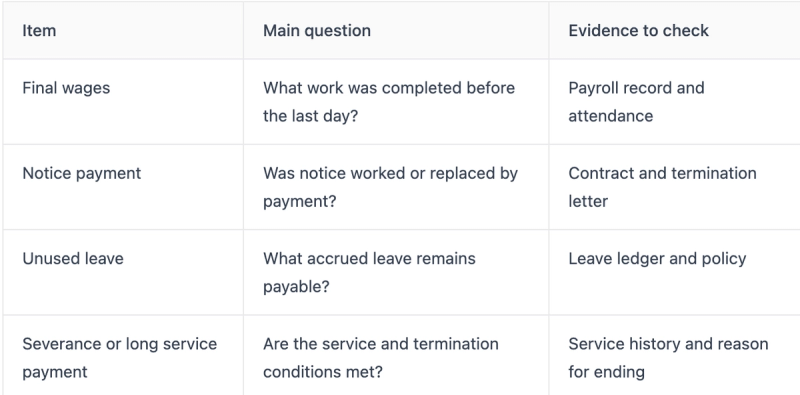
The table helps organize the file, but the employer should still test each item against the current Ordinance, the contract, and the employee’s actual service history. Calculations should be explained before payment wherever possible.
6. Benefits outside the Employment Ordinance
Many benefits employees value are not statutory benefits under the Employment Ordinance. MPF, employee compensation insurance, private medical coverage, and employer-funded wellness programs have different legal and contractual foundations. Describing them accurately prevents employees from assuming that a discretionary benefit has the same protection as statutory leave.
a. How MPF requirements differ from statutory employment benefits
MPF is a retirement-savings system governed by separate legislation and rules. Contributions, exemptions, enrollment, and recordkeeping should be handled through the MPF framework rather than folded into a general leave or payroll policy. An employer may offer additional retirement or health benefits, but those arrangements do not replace mandatory MPF duties.
b. The role of the Employees’ Compensation Ordinance
The Employees’ Compensation Ordinance addresses compensation for injuries and occupational diseases arising from employment. It operates alongside, not inside, the Employment Ordinance. Employers should maintain the required insurance and know whom to contact after an incident, while employees should report injuries promptly and keep medical documentation.
c. Contractual insurance, bonuses, and private health benefits
Private medical insurance, wellness allowances, bonuses, and flexible spending arrangements usually arise from the employment contract or an employer policy. Their scope depends on the written terms, eligibility rules, provider conditions, and any reservation of discretion. The MixCare Health Wellness Marketplace is one example of a configurable workplace benefit approach, with access to wellness providers through its platform; it is not a substitute for statutory leave or compensation duties.
d. When immigration and visa rules affect employment
Immigration status can affect whether a person may work, for whom, and under what conditions. A valid employment contract does not by itself replace a required visa or permission. Employers should verify the applicable immigration conditions and keep employment, identity, and privacy records securely, with access limited to legitimate business needs.
7. How to check compliance and resolve disputes
Compliance is easier when employers review the employment lifecycle in order: hiring, payroll, leave, workplace protection, and termination. Employees can use the same sequence to identify where an entitlement may have been missed. The goal is an accurate, documented discussion before a disagreement hardens into a claim.
a. Documents employees should review and retain
Employees should keep the offer letter, employment contract, handbook, payslips, leave approvals, medical certificates, MPF information, and termination documents. They should also save material changes to salary, duties, working hours, or benefits. These records help distinguish a one-off administrative mistake from a continuing policy issue.
b. Internal complaint and payroll review procedures
An internal review should identify the issue, preserve relevant records, check the contract and statutory rule, and provide a written response. Payroll errors should be corrected promptly, with any arrears and calculation method explained. Employers can make this process easier through a designated HR contact and a clear escalation route; smaller businesses can begin with a simple shared checklist.
c. Labour Department conciliation and claims processes
Where internal discussions fail, the Labour Department may provide information, conciliation, or access to relevant claims procedures depending on the dispute. Employees should bring contracts, payslips, attendance records, and correspondence. The precise forum and time limit depend on the claim, so parties should check the current official process before filing.
d. Penalties, deadlines, and when to seek legal advice
Failure to pay wages, provide statutory benefits, or comply with protective rules can expose an employer to orders, penalties, and reputational damage. Deadlines vary by claim and should never be guessed from an old policy. Legal advice is sensible where the dispute involves discrimination, protected leave, injury, complex termination payments, multiple entities, or a disputed employee-versus-contractor relationship.
Conclusion
Hong Kong employment ordinance benefits requirements are best managed as a connected set of statutory, contractual, and operational responsibilities. Employers that keep accurate records and explain their policies clearly are better placed to pay correctly, administer leave fairly, and resolve issues early, while employees benefit from knowing which documents and legal protections support their position.
Frequently Asked Questions
What does the Hong Kong Employment Ordinance cover?
It covers core employment protections including wages, rest days, statutory holidays, annual leave, sickness allowance, maternity and paternity protections, termination rules, and certain service-based payments.
Does every part-time employee receive the same benefits?
Basic protections may apply broadly, but eligibility for additional benefits can depend on continuous-contract status, service length, hours worked, and other statutory conditions.
Must an employment contract be in writing?
Employment terms should be communicated clearly, and written terms are strongly recommended. A contract may include express and implied terms even where the arrangement began orally.
How are statutory holidays different from annual leave?
They are separate entitlements with different rules. An employer should explain the holiday calendar and track annual leave independently from statutory holidays.
Can an employer dismiss someone while they are on sick or maternity leave?
Protected circumstances can restrict dismissal and create liability if the decision is connected to the protected absence or status. The facts and statutory exceptions must be reviewed carefully.
Are MPF contributions part of Employment Ordinance benefits?
No. MPF is governed by separate legislation, although it is commonly administered through payroll and considered part of an employee’s overall benefits package.
Where can an employee raise an employment dispute?
The employee can first use the employer’s internal complaint process and may then seek information, conciliation, or a claim through the Labour Department or another appropriate forum, depending on the issue.
MixCare Health
MixCare Health · Hong Kong