
Staying compliant with Hong Kong’s Mandatory Provident Fund (MPF) requirements is essential for every employer. This 2026 compliance checklist helps HR teams and business owners review employee enrolment, mandatory contributions, payment deadlines and record-keeping obligations. Use this practical guide to identify potential compliance gaps, strengthen payroll processes and keep employee MPF records accurate and up to date.
Key Takeaways
A compliant MPF process depends on accurate payroll data, timely remittances, and records that can be explained months later. Use this Hong Kong MPF employer compliance checklist 2026 as a practical framework, then confirm case-specific details with the MPFA or your trustee.
- Enrol eligible employees within the applicable deadline and provide the required scheme information.
- Calculate employer and employee contributions from the employee’s relevant income.
- Remit contributions on time and investigate exceptions promptly.
- Keep payroll, trustee, bank, employee-notice, and enrollment records together.
- Review exits, exemptions, special workers, and 2026 rule changes before each payroll cycle.
1. Understand your MPF employer obligations in 2026
MPF compliance is an ongoing payroll responsibility rather than a one-time enrollment task. Employers need a clear process for identifying eligible workers, calculating contributions, sending payments, and retaining evidence. The rules can interact with employment terms, payroll timing, and changes in an employee’s status. For a useful second perspective on contribution rates and deadlines, consult this MPF employer guide, while treating official guidance as the final authority.
a. Which businesses and employees must participate
Most Hong Kong employers with eligible employees must participate in an MPF scheme. In general, employees between ages 18 and 64 who have completed the relevant employment period must be enrolled, although the treatment of casual and other categories can differ. Check the employment arrangement, age, duration, and any applicable statutory exception before deciding that a worker can be left out.
The employer normally selects a registered scheme, enrolls eligible staff, deducts the employee share, and makes the matching employer contribution. Payroll should record the employee’s start date clearly because the enrollment deadline is tied to commencement of employment, not to the date the first payroll is run.
b. Who may be exempt from MPF enrollment
Some people may fall outside the ordinary enrollment requirement, including certain short-term employees, covered workers from overseas arrangements, and individuals already protected by specified statutory or occupational schemes. Exemption rules are fact-sensitive, so an assumption based only on job title or nationality is risky. Keep the reason and supporting documents whenever a worker is treated as exempt.
A practical review asks whether the person’s employment is genuinely short term, whether another recognized retirement arrangement applies, and whether the facts have changed since hiring. If uncertainty remains, document the question and obtain advice rather than silently excluding the employee.
c. Employer and employee contribution responsibilities
The employer is responsible for deducting the employee contribution correctly, adding the employer contribution, and remitting both amounts through the selected scheme’s process. The employee contribution should not be treated as an optional payroll deduction. Employees should also receive information that allows them to understand the scheme and the amounts being paid on their behalf.
For ordinary monthly-paid employees, the commonly applied rate is 5% of relevant income for each side, subject to the statutory income levels. The exact treatment can vary by pay frequency and worker category, so payroll instructions should state the calculation method rather than relying on a generic percentage alone.
d. Key 2026 rule changes to verify before payroll processing
Before processing 2026 payroll, verify current MPFA notices, trustee instructions, and any changes affecting digital administration, contribution limits, or employment benefits. The eMPF Platform and related administrative changes may alter how employers submit information, even when the underlying contribution calculation remains familiar. A check of current guidance is especially important after the 2025 change to the treatment of severance and long-service payments.
Do not copy figures from an old payroll template without checking its effective date. A short annual rules review should confirm contribution thresholds, remittance arrangements, employee categories, and any updated forms or electronic procedures.
2. Set up compliant MPF enrollment and scheme administration
A reliable setup gives payroll, HR, finance, and employees the same operating picture. It begins with a registered scheme and continues through enrollment, notices, contribution instructions, and controlled access to employee data. Good administration reduces repeated questions and makes later reconciliation much easier.

a. Choosing and registering an MPF scheme
An employer should select an approved MPF scheme and complete the trustee’s registration and employer documentation before contributions are due. Compare administration channels, reporting arrangements, investment choices, service contacts, and the practical way corrections will be handled. The lowest apparent administrative effort is not necessarily the best fit if payroll cannot obtain timely confirmations.
Create an internal scheme record containing the employer account details, trustee contact information, submission method, payment instructions, and authorized users. Restrict changes to this record, since an incorrect trustee account or remittance reference can turn an otherwise accurate payroll run into a payment exception.
b. Enrolling eligible employees on time
The usual enrollment window for an eligible employee is within 60 days of employment commencement, subject to the applicable rules. Build an alert from the signed start date, not from the employee’s first salary date, and assign an owner for any case approaching the deadline. Late enrollment should be escalated immediately rather than waiting for the next monthly close.
At onboarding, collect the information needed by the trustee and check it against the employee’s identity and payroll record. A simple status such as “pending information,” “submitted,” or “confirmed” helps HR see which cases still require action.
c. Providing scheme information and enrollment documents
Employees should receive the scheme information, enrollment forms, contribution details, and relevant notices required by the trustee or applicable rules. Explain what will be deducted, when deductions begin, and whom the employee should contact about account or investment questions. Keep evidence of delivery, including electronic delivery where the process supports reliable recordkeeping.
The explanation does not need to be lengthy, but it should be understandable. A standard onboarding pack, paired with a process for answering individual questions, is more dependable than an informal message that may not be retained.
d. Handling employees who have existing MPF accounts
An employee may already have an MPF account from earlier employment, but that does not remove the new employer’s responsibility to enroll the employee in the employer’s scheme where the rules require it. Ask for the information needed to complete the new enrollment and avoid promising that contributions can simply be redirected to a preferred personal account.
Employees can generally make their own choices about permitted transfers or investment arrangements through the appropriate process. HR should provide neutral procedural information and direct account-specific questions to the trustee.
3. Calculate and process MPF contributions correctly
Contribution accuracy depends on defining relevant income before applying the rate and statutory limits. Payroll teams should separate ordinary wages from payments that need special treatment, then retain the calculation behind each remittance. A clear monthly timetable matters because a correct amount submitted late can still create a compliance problem.
a. Identifying relevant income for contribution purposes
Relevant income generally includes wages, salary, leave pay, fees, commissions, bonuses, and certain allowances or other employment-related payments, subject to the governing rules. Do not decide by looking only at the employee’s fixed monthly salary. Review the nature and timing of each payment, especially where compensation is variable or paid irregularly.
Payroll should map each pay code to an MPF treatment and record who approved that mapping. When a new bonus, allowance, or deduction is introduced, update the mapping before the payment reaches the payroll run rather than correcting it retrospectively.
b. Applying the minimum and maximum relevant income levels
After identifying relevant income, apply the minimum and maximum relevant income levels in force for the relevant contribution period. For many monthly-paid employees, the familiar maximum monthly relevant income is HK$30,000, producing a 5% maximum monthly contribution of HK$1,500 for each side, but employers should verify current thresholds and worker-specific rules before relying on those figures.
The following simplified view is useful as a control, not as a substitute for the applicable rules:
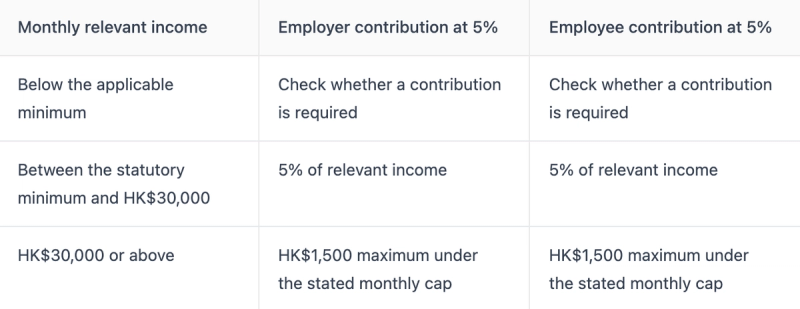
The table helps reviewers spot a common error: applying the cap to only one side or applying it before all relevant income has been identified. Keep the underlying pay-code calculation with the remittance evidence.
c. Meeting contribution deadlines
For monthly-paid employees, contributions are generally due by the 10th day of the following month, although the applicable deadline can depend on the worker’s pay cycle and scheme arrangements. Schedule the payroll close early enough to allow bank processing, trustee validation, and correction of rejected files. Do not treat the submission date as proof that the trustee received cleared funds.
Record the remittance date, payment reference, trustee acknowledgment, and any rejected or pending items. If a bank holiday or system outage affects timing, follow the trustee’s current instructions and retain evidence of the steps taken.
d. Correcting late, missed, or inaccurate payments
When a payment is late or wrong, quantify the difference, identify affected employees, and contact the trustee promptly. A correction should cover the contribution shortfall, any applicable surcharge or interest, and the employee communication needed to explain the adjustment. Avoid silently netting an old error against a new payroll unless the trustee confirms that approach.
Keep an exception log showing the original amount, corrected amount, reason, approval, payment date, and closure evidence. This turns an isolated mistake into a traceable remediation record and helps prevent the same payroll rule from failing again.
4. Manage payroll data and employee changes
MPF administration works best when HR events and payroll events are connected. A new hire, resignation, unpaid leave period, transfer, or change in bank details can affect more than one system. Define who initiates the change, who reviews it, and when the trustee must be notified.

a. Coordinating payroll records with MPF calculations
Reconcile the employee roster, pay codes, contribution report, and trustee file before each submission. The employee identifier, start date, pay period, relevant income, employer contribution, employee contribution, and payment status should agree across the records. A documented reconciliation is especially valuable when payroll is outsourced or several systems feed the same remittance file.
Use controlled versions of payroll templates and limit manual edits after approval. If a change is unavoidable, require a second review and preserve both the original and corrected calculation.
b. Handling new hires, resignations, and transfers
New hires should flow from the HR onboarding record into the enrollment tracker, while resignations should trigger a final contribution review and an exit notification where required. Transfers between entities or payroll groups need particular care because the employing legal entity, scheme, and contribution deadline may change. Never assume that a transfer is merely an internal department change.
Use an event checklist covering the effective date, final pay, outstanding contributions, trustee notification, employee communication, and record retention. This keeps a small HR change from becoming a missing remittance or an unexplained gap in the employee account.
c. Processing unpaid leave, bonuses, and variable pay
Unpaid leave can change the amount of relevant income and the timing of payroll, while bonuses and commissions may need to be included according to their character and payment date. Establish written treatment for recurring variable pay and review one-off payments individually when their classification is unclear. The payroll system should show the rule applied, not only the final amount.
Run a post-payroll exception report for employees whose income differs materially from the prior period. A reviewer can then confirm whether the difference reflects a legitimate leave period, bonus, correction, or data error.
d. Updating employee details and contribution instructions
Changes to a name, address, identity document, bank details, employment status, or contribution instruction should be supported by an approved employee request or HR record. Update the trustee and payroll records through the authorized channel, then check that the change appears in the next available statement or report.
Do not email sensitive information broadly or retain duplicate copies without a purpose. A short access list and a clear change log are often more useful than an uncontrolled folder full of old forms.
5. Maintain records, notices, and compliance evidence
Records should tell the story of each contribution from the employee’s pay calculation to the trustee’s receipt. Retention periods and required formats should be checked against current law, trustee terms, and internal policy. The aim is not to create paperwork for its own sake, but to make a timely answer possible when an employee, auditor, trustee, or regulator asks a question.
a. Records employers must retain
Retain enrollment forms, exemption assessments, payroll registers, relevant-income calculations, remittance statements, payment confirmations, employee notices, correction logs, and correspondence with the trustee. Keep a record of who approved changes and when they took effect. If an external payroll provider is involved, the contract and service reports should also show how MPF responsibilities are divided.
Organize files by pay period and employee or by a consistent indexed reference. Whatever structure you choose, ensure an independent reviewer can trace a reported contribution back to its source payroll data.
b. Contribution statements and payment confirmations
A bank transaction alone may not prove that the trustee allocated contributions correctly. Match the bank payment to the remittance statement, employee-level detail, trustee acknowledgment, and payroll totals. Investigate unmatched balances while the relevant payroll run is still familiar to the team.
A monthly evidence pack can include the approved payroll report, remittance file, trustee receipt, bank confirmation, exception log, and reviewer sign-off. This compact pack is easier to inspect than scattered screenshots and email chains.
c. Employee communications and required notices
Give employees the required scheme information and notices within the applicable timeframes, and retain evidence that the materials were delivered. When a correction affects an employee’s deduction or contribution record, explain the adjustment plainly and provide a contact route for questions.
Communication should distinguish between payroll facts and investment guidance. HR can explain the administrative process, while account-specific or investment questions should be directed to the trustee or another appropriately authorized source.
d. Protecting personal and payroll information
MPF records contain identity, compensation, and financial information, so access should be limited according to role. Use secure transfer methods, multi-factor authentication where available, retention rules, and a process for handling suspected disclosure or unauthorized access. Periodically remove copies that no longer have a legitimate retention purpose.
For organizations reviewing broader benefits administration controls, MixCare Health documents an eight-layer security architecture, including end-to-end encryption, role-based access controls, regional data residency, continuous monitoring, and audit trails. Those capabilities concern MixCare Health’s platform and should not be confused with MPF trustee obligations, but they illustrate the level of control expected when sensitive employee data is handled digitally.
6. Handle employee exits and special employment situations
Departures and unusual employment arrangements deserve a separate review because the normal monthly workflow may not fit. The final payroll, last contribution, trustee notification, and employee communication must align with the actual employment end date. Keep the decision trail where a case involves a disputed payment, exemption, or statutory benefit.
a. Stopping contributions when employment ends
When employment ends, confirm the effective termination date, calculate any final relevant income, and submit the final contribution through the applicable process. Do not stop deductions merely because an employee has stopped attending work if salary, notice pay, or another payment remains relevant. Check the trustee’s departure requirements and retain the acknowledgment.
The employee should be told what administrative step has been taken and how to contact the trustee about the account after departure. Payroll should also close any recurring instruction so that a former employee is not included in a later file.
b. Managing long-service and severance payment arrangements
The abolition of MPF offsetting for newly accruing severance and long-service payment liabilities from May 2025 requires employers to review how these obligations are funded and recorded. The change is separate from the ordinary monthly MPF contribution calculation, but it affects workforce-cost planning and termination procedures. Obtain current legal or professional advice for the facts of each payment.
Maintain separate records for MPF contributions and statutory severance or long-service liabilities. Combining them in one general ledger description can obscure whether the correct obligation was calculated and paid.
c. Supporting employees who change jobs or schemes
When an employee changes jobs, the new employer must follow its own enrollment process, while the employee may have options for handling accumulated MPF benefits through the permitted trustee procedures. HR should avoid giving individualized investment advice or promising a transfer outcome. Provide the relevant trustee contact details and explain which forms or deadlines belong to the employee.
If a scheme change affects the employer’s workforce, communicate the effective date, administrative steps, and any period during which payroll or account information may look different. Keep the communication and implementation approval together.
d. Addressing part-time, temporary, and cross-border workers
Part-time and temporary workers are not automatically outside MPF requirements. Review age, employment duration, pay frequency, casual status, and the precise contractual arrangement. Cross-border workers also require careful analysis of the applicable exemption or coverage rules rather than a decision based only on where the employee lives.
Create a separate case category for these workers so that the reviewer is prompted to check the relevant rule. If the facts change—for example, a temporary engagement becomes ongoing—reassess eligibility and record the new decision.
7. Prepare for MPF reviews, penalties, and annual checks
A review should test whether the process works in practice, not just whether a policy exists. Monthly checks catch errors while payroll data, trustee files, and approvals are still available. Annual checks should then examine trends, access rights, changes in law, and whether earlier corrective actions actually stayed corrected.
a. Running a monthly employer compliance review
Assign one owner to complete the review and another person to approve it. The review should compare the active employee list with the enrollment tracker, test contribution calculations, confirm deadlines, and inspect unresolved exceptions. A short recurring routine is more reliable than an annual scramble.
A practical monthly sequence might include:
- Confirming new hires, exits, transfers, exemptions, and changes in pay status.
- Recalculating a sample of ordinary, variable-pay, and capped contributions.
- Matching the remittance statement and trustee acknowledgment to the bank payment.
- Reviewing rejected files, late items, corrections, and employee complaints.
After the check, record the reviewer, date, exceptions, owner, due date, and closure evidence. Management should be able to see not only that a review occurred, but also what happened to the issues it found.
b. Reconciling payroll, trustee, and bank records
Reconciliation should begin with totals and then move to employee-level differences. Compare the payroll register with the remittance file, trustee allocation report, and bank statement, paying attention to duplicate payments, missing employees, returned funds, and rounding differences. Resolve any variance before marking the period complete.
Where a trustee report arrives later than the payroll close, mark the reconciliation as pending rather than signing it off prematurely. Complete the review when the final evidence is available and preserve the date of completion.
c. Responding to inquiries or inspections
Nominate a contact for MPFA, trustee, employee, or auditor inquiries and keep a response log. Gather the requested period, source records, calculation notes, approvals, and correspondence before replying. Answers should be factual and consistent with the underlying files; do not recreate a calculation from memory.
If an inquiry identifies a wider issue, expand the sample beyond the named employee or month. Promptly correcting a systemic problem is more defensible than treating every finding as an isolated exception.
d. Identifying penalties and remediation steps
Late or missed contributions can lead to surcharges, financial penalties, and further enforcement, depending on the circumstances. The precise consequence should be confirmed from current official guidance and trustee instructions. Once an issue is found, calculate exposure, pay or correct the shortfall, notify affected parties where required, and document the root cause.
Remediation may involve changing a payroll rule, adding an approval step, retraining staff, correcting employee data, or improving system controls. Close the action only after testing a later payroll cycle or other evidence shows that the fix works.
e. Using a 2026 compliance calendar and sign-off process
Build the calendar around payroll dates, the contribution deadline, onboarding windows, trustee reporting, annual policy review, and planned system changes. Include reminders for verifying 2026 thresholds and administrative instructions rather than assuming that last year’s settings remain valid. The calendar should name a primary owner and a backup for every recurring action.
At year-end, review exception trends, unresolved employee cases, access permissions, data retention, and the treatment of special payments. Senior sign-off should confirm that the employer has reviewed both routine contributions and the less frequent events that can create the greatest risk.
Use the video as supplementary orientation only, not as a substitute for current MPFA or trustee instructions. A signed annual review, supported by the monthly evidence packs, gives the organization a defensible record of how its MPF process was managed throughout 2026.
Conclusion
A sound Hong Kong MPF employer process connects enrollment, payroll calculation, remittance, employee communication, data protection, and review evidence. Treat each monthly contribution as a controlled workflow, verify 2026 changes before relying on old settings, and address exceptions while the facts are still easy to trace.
Frequently Asked Questions
When must an eligible employee be enrolled in an MPF scheme?
An eligible employee is generally enrolled within 60 days of employment commencement, subject to the applicable rules and any relevant worker category or exemption.
What is the usual MPF contribution rate?
For many ordinary employees, the employer and employee each contribute 5% of relevant income, subject to the statutory minimum and maximum relevant income levels.
When are monthly MPF contributions due?
For monthly-paid employees, contributions are generally due by the 10th day of the following month, but employers should confirm the deadline for the relevant pay cycle and scheme.
What counts as relevant income?
Relevant income can include wages, salary, leave pay, fees, commissions, bonuses, and certain allowances or other employment-related payments. The treatment depends on the applicable rules and payment circumstances.
Can an employee with an existing MPF account skip the new employer’s scheme?
Usually not. An existing account does not generally remove the new employer’s obligation to enroll an eligible employee in the employer’s scheme.
What should an employer do after a late or incorrect contribution?
Contact the trustee, quantify and correct the shortfall, pay any applicable surcharge or penalty, notify affected employees where required, and retain a complete remediation record.
How long should MPF records be kept?
Employers should follow the applicable statutory, trustee, and internal retention requirements. Records should remain accessible, secure, and detailed enough to trace payroll amounts to trustee receipt and employee communication.
MixCare Health
MixCare Health · Hong Kong