
Discover how Hong Kong employers can design employee benefits that meet the diverse needs of a multigenerational workforce. From flexible benefits and healthcare support to cost management, learn how to create a more inclusive and effective benefits strategy.
Key Takeaways
A multigenerational workforce needs benefits that are fair at the foundation and flexible at the edges. The strongest programs combine local compliance, practical choice, inclusive access, and disciplined review.
- Segment employees by needs and life circumstances, not age labels alone.
- Protect core medical, retirement, and family needs before adding optional features.
- Use modular benefits so employees can direct value toward relevant priorities.
- Make digital tools convenient while preserving human and non-digital support.
- Measure use, satisfaction, cost, and retention, then improve the program regularly.
1. Understand the needs across Hong Kong’s workforce generations
Designing employee benefits for Hong Kong’s multigenerational workforce starts with curiosity rather than assumptions. Employees may share a generation but differ sharply in income, health, family structure, housing situation, and comfort with digital services. A useful program therefore looks at the whole person and the realities of working life in Hong Kong. It should also leave room for needs to change over time.
a. Move beyond stereotypes when segmenting employee needs
Generational labels can help identify questions, but they should not determine the answer. A younger employee may be supporting parents, while an older employee may want mobile self-service and flexible career arrangements. Segment research by factors such as role, income, location, tenure, dependents, health needs, and work pattern, then compare those findings with age-related patterns rather than treating age as a proxy.
A practical segmentation exercise can use broad groups for planning, followed by individual choice at enrollment. This avoids designing a “young employee” package that overlooks caregiving or a “senior employee” package that assumes low digital confidence. Research on tailoring employee benefits is useful as a prompt, but local employee evidence should lead the final design.
b. Compare life stages, financial priorities, and caregiving responsibilities
Life stage often explains benefits preferences more clearly than birth year. Someone early in a career may value outpatient support, mental health resources, and help with immediate expenses. A parent may prioritize dependent coverage and leave, while an employee caring for an aging parent may need flexibility, practical care support, and a stronger financial safety net.
Use listening sessions and surveys to ask what employees would use, what they currently pay for themselves, and which benefits feel difficult to access. Include questions about dual caregiving, since employees may support children and parents at the same time. The result should be a benefits menu that recognizes competing demands without requiring employees to disclose more personal information than necessary.
c. Account for Hong Kong’s cost of living and housing pressures
Housing costs, commuting time, medical expenses, and family obligations shape how employees experience total compensation. A benefit that looks generous on paper may have limited value if it requires a large upfront payment or cannot be used near home or work. Employers should test proposed benefits against realistic household budgets rather than relying only on annual allowance figures.
This also means explaining value in Hong Kong dollars and in familiar situations. Show how an outpatient allowance, reimbursement process, or dependent-care benefit works in practice, including any limits and employee contributions. Clear examples help employees compare benefits with the expenses they are already managing.
d. Use employee data and listening methods to validate assumptions
Start with existing utilization, claims, enrollment, absence, and employee survey data, subject to privacy requirements. Then add listening methods that reveal why a benefit is or is not being used. A low claim rate may indicate good health, but it may also reflect confusing eligibility rules, inconvenient providers, or concern about making a claim.
Build a simple evidence cycle: establish a baseline, test a focused change, review the result, and ask employees what happened. Keep demographic reporting sufficiently aggregated to protect privacy. The goal is not to monitor individuals; it is to understand whether the program is reaching different groups fairly.
2. Build a benefits foundation that supports everyone
Flexibility works only when the underlying program is dependable. Employees need to understand their statutory protections, medical coverage, retirement arrangements, and eligibility before they can make meaningful optional choices. Build the foundation first, then add modular features where they solve a clear need.

A strong foundation also reduces confusion for managers and HR teams. Document who qualifies, what is covered, how claims or reimbursements work, and where employees can get help. Clarity is a benefit in its own right, especially when household budgets are under pressure.
a. Review statutory requirements, MPF, and employer obligations
Map the program against Hong Kong employment requirements, Mandatory Provident Fund responsibilities, leave provisions, and applicable insurance or workplace obligations. This is a governance exercise as much as a design exercise: assign owners, record review dates, and keep employee communications consistent with the approved terms.
Separate statutory obligations from discretionary benefits in every guide and enrollment flow. Employees should be able to see what the employer must provide, what the company chooses to add, and what costs or conditions apply. Legal and privacy review should happen before launch, not after a complaint exposes a gap.
b. Strengthen core medical and insurance protection
Medical protection should be understandable, usable, and appropriate to the workforce’s actual needs. Review outpatient access, hospitalization protection, preventive care, mental health support, dependent coverage, exclusions, provider access, and employee co-payments. Do not assume that a higher headline limit automatically creates higher value.
Explain the path from appointment to payment or reimbursement in plain language. If employees need to submit documents, state which ones, where to submit them, and how support is provided. A clear process is especially valuable for employees who are managing illness alongside work or caregiving.
c. Balance retirement readiness with immediate financial needs
Retirement planning matters across generations, but employees do not experience it in the same way. Some need help understanding long-term contributions, while others are coping with rent, family costs, debt, or unexpected medical spending. Benefits communication should therefore connect future security with present-day financial realities.
Offer education without assuming that every employee can increase savings immediately. Consider whether flexible financial support, budgeting resources, or carefully designed allowances can complement retirement communication. The right balance protects long-term readiness without making the program feel irrelevant to employees facing immediate costs.
d. Make benefits equitable for full-time, part-time, and nontraditional workers
Eligibility rules should reflect the workforce as it actually operates. Review coverage for part-time staff, fixed-term employees, shift workers, contractors where applicable, and employees returning from leave. If different treatment is necessary, explain the reason and assess whether the gap creates a material disadvantage.
Equity does not always mean identical benefits. It means using consistent principles, offering reasonable access, and avoiding administrative barriers that disproportionately affect certain groups. Publish a concise eligibility matrix and give HR a process for handling edge cases fairly.
3. Design flexible benefits around different life stages
A flexible program lets employees direct part of the employer’s investment toward needs that matter to them. It should not become a confusing catalog of minor perks. Begin with a manageable set of categories, define the boundaries clearly, and make choices easy to compare.
a. Offer modular choices instead of one standard package
A menu can include medical support, wellness, family assistance, financial education, and lifestyle categories, depending on the employer’s objectives and budget. Keep essential protection outside the choice architecture when removing it would create unacceptable risk. Optional spending should add relevance, not replace the basics.
The model described in Flexible Spending Account materials illustrates why configurable wallets can be useful: employers define eligible categories while employees direct funds toward approved health and wellness expenses. Any implementation should still set clear limits, expiry rules, documentation requirements, and support channels.
b. Support employees with children, aging parents, or dual caregiving duties
Caregiving benefits should recognize that responsibilities can be simultaneous and unpredictable. Consider dependent-care assistance, elder-care information, flexible scheduling, caregiver leave, and access to counseling or navigation support. Employees may not need every option, but they should not have to choose between an inflexible benefit and financial strain.
Ask employees when support is most useful: during appointments, school closures, hospital stays, or periods of intensive home care. This timing information can improve both benefit design and manager guidance. It also helps avoid offering a nominal benefit that cannot be used during the moments of greatest need.
c. Include family-friendly leave and dependent-care assistance
Leave policies should be easy to find and understandable before an employee needs them. Set out eligibility, notice periods, documentation, pay treatment, and return-to-work expectations without burying the practical details in a long policy document. Dependent-care support can complement leave by helping employees remain at work when a short absence would otherwise become unavoidable.
Review whether policies work for different household structures, including single parents, blended families, and employees caring for relatives. Ask managers to apply the process consistently. Small differences in interpretation can otherwise create a large difference in employee experience.
d. Set clear eligibility rules and prevent unintended inequities
Every flexible option needs a simple answer to four questions: who can use it, for what purpose, when, and with what evidence. Test the rules with employees who work different shifts, have different dependents, or use different devices. This catches practical barriers before they become disputes.
Provide an exception route for unusual circumstances, but record decisions and review patterns. If one group repeatedly needs exceptions, the policy may be poorly designed. Flexibility should be built into the program rather than granted informally by individual managers.
4. Combine digital convenience with inclusive access
Digital administration can make enrollment, claims, and benefit discovery faster, but convenience is not the same as inclusion. Employees vary in device access, language preference, disability, confidence, and willingness to manage sensitive information online. A good experience gives people choice without creating two different standards of service.

Use the digital channel for speed and visibility, then support it with clear human assistance. Before launch, test the experience from an employee’s perspective: can they understand the choice, complete the action, and find help without repeatedly contacting HR?
a. Create a simple benefits experience for mobile-first employees
Keep the employee journey focused on the decisions that matter. Show available allowances, eligibility, deadlines, coverage details, and next steps in a consistent order. Avoid forcing employees to interpret technical terms or search across several disconnected documents.
Mobile access is most useful when it supports a complete task, not merely a dashboard. Employees should be able to review options, submit required information where appropriate, check status, and find support. Use plain language and test the flow with employees from different age groups and roles.
b. Provide non-digital enrollment and support options
Offer assisted enrollment, printable summaries, telephone support, or scheduled help sessions for employees who cannot or do not wish to complete the process online. These options also help employees with limited connectivity, language barriers, or complex family situations. The aim is equal access to the benefit, not identical use of the channel.
Make the offline route visible from the start. If it is hidden in a footer or only offered after a failed digital attempt, employees may conclude that support is unavailable. Track questions and abandoned enrollments to identify where the digital process needs improvement.
c. Improve accessibility for older employees and people with disabilities
Accessibility should cover content, interaction, and service. Use readable type, sufficient contrast, keyboard-friendly navigation, captions for video, descriptive labels, and documents that work with assistive technology. Provide a human route for employees who need help interpreting or completing a task.
Involve employees with different access needs in testing rather than treating accessibility as a final compliance check. Small changes, such as a clearer summary or fewer steps, often improve the experience for everyone.
d. Protect personal data when using benefits platforms
Benefits administration can involve health, family, and financial information. Limit collection to what is necessary, explain how data is used, apply role-based access, and retain information only for appropriate periods. Vendor due diligence should cover security controls, incident procedures, subcontractors, and data-handling responsibilities.
For Hong Kong employers, privacy review should align the program with applicable requirements and internal governance. Give employees a clear contact for privacy questions, and do not use sensitive data for unrelated employment decisions without a lawful and transparent basis.
5. Support health, well-being, and longer working lives
Well-being benefits are most useful when they connect to real health needs and everyday working conditions. A multigenerational workforce may require preventive care, chronic-condition support, mental health resources, ergonomic adjustments, and flexible work practices at the same time. Treat these as connected parts of workforce health rather than isolated perks.
a. Combine preventive care with mental health support
Preventive care can include screenings, health education, vaccination support, nutrition resources, and activity programs, subject to the employer’s chosen scope. Mental health support should be easy to find and confidential, with clear boundaries around what managers and HR can see. Employees are more likely to use a service when the access route is simple and the purpose is explained without stigma.
MixCare Health’s wellness events offering is described as a catalogue of vetted workshops, health talks, and team activities covering areas such as mindfulness, nutrition, and preventive care. Employers considering any events program should connect sessions to employee interest and make attendance practical across shifts and work locations.
b. Address chronic conditions and age-related health concerns
Review aggregate health patterns to understand where support may be needed, while protecting individual confidentiality. Chronic conditions can affect employees at any age, and older employees may need more support with screenings, mobility, medication management, or gradual changes in work demands. Benefits should assist people without labeling them by age or diagnosis.
Pair coverage with navigation. Employees need to know where to seek advice, which costs are covered, and how to continue care during leave or a change in work pattern. Clear guidance can reduce delayed care and avoidable administrative stress.
c. Design workplace flexibility across roles and career stages
Flexibility cannot mean the same arrangement for every role. Some employees may work remotely, others may need predictable shifts, and frontline teams may benefit from schedule-swapping or phased return arrangements. Map what is operationally possible by role, then apply the principle consistently.
Career stage also matters. Employees approaching retirement may value phased transitions, while new hires may need structured learning and predictable support. Managers should discuss arrangements based on work requirements and individual circumstances, not assumptions about age.
d. Connect well-being programs to workload and manager practices
A meditation session cannot compensate for chronic understaffing, unclear priorities, or managers who discourage leave. Review workload, staffing, meeting norms, psychological safety, and manager behavior alongside well-being participation. The program should reduce friction in working life rather than place responsibility for stress entirely on employees.
Use manager training, pulse surveys, absence patterns, and qualitative feedback to find workplace causes. If participation is low, ask whether timing, trust, workload, or confidentiality is the real barrier. That answer is more useful than simply adding another activity.
6. Control costs while improving employee value
Cost control should focus on value, not only on reducing the benefits budget. A low-cost benefit that employees cannot use may deliver less value than a targeted option with clearer demand. Compare utilization, employee contribution, administration, claims experience, and retention relevance before making a change.
a. Prioritize benefits by employee impact and business objectives
Rank benefits against a small set of agreed criteria: employee reach, health or financial impact, strategic relevance, administrative effort, and affordability. Separate universal foundations from targeted options, and document why each item remains in the package. This creates a defensible process when budgets tighten.
A modular approach can also make trade-offs visible. Employees receive meaningful choice within defined limits, while the employer retains control over eligible categories and total spend. The menu should remain small enough that employees can make an informed decision.
b. Compare subsidies, allowances, insurance, and reimbursement models
Each funding model shifts cost, administration, and decision-making differently. A subsidy may be simple but less targeted; an allowance can offer choice but requires clear rules; reimbursement may preserve control but create paperwork; insurance can provide broad protection but may include rigid terms and pricing.
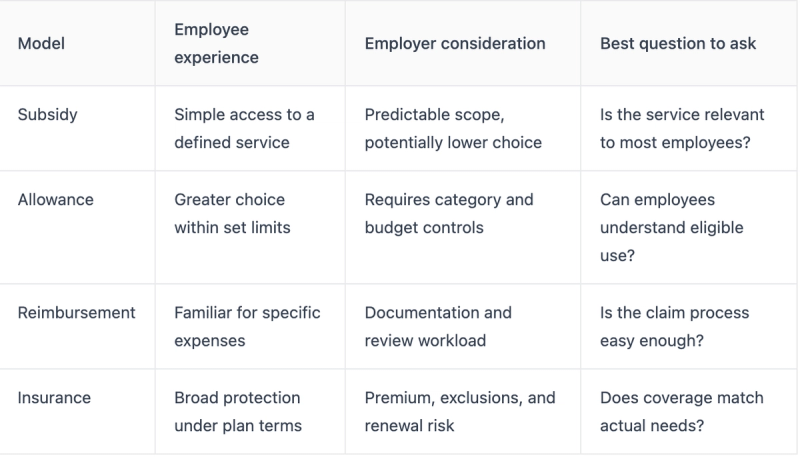
The comparison does not produce one universal answer. It helps the employer choose deliberately and explain why different benefits use different funding methods.
c. Manage plan costs without shifting excessive risk to employees
Set employer contributions, limits, and employee co-payments with care. Excessive cost shifting can make a benefit technically available but practically unused, especially for lower-paid employees or households with high medical needs. Review the distributional effect of any deductible, cap, or exclusion before approval.
Consider targeted support where a uniform contribution would create inequity. Also monitor whether employees delay necessary care because of cost. Sustainable design protects the budget without turning financial pressure into health risk.
d. Measure participation, satisfaction, retention, and claims outcomes
Create a baseline before changing the program. Track enrollment, utilization, claims or reimbursement patterns, employee satisfaction, support contacts, absence where appropriate, and retention trends. Interpret the measures together: high participation with low satisfaction may signal poor quality, while low participation may reflect access barriers.
Review results by relevant employee segments only where sample sizes and privacy controls make that appropriate. Share the main lessons with leadership and employees, including what will change and what will remain. Measurement builds trust when it leads to visible improvement rather than surveillance.
7. Launch, communicate, and continuously improve the program
Even a well-designed package can fail if employees do not understand it at the moment they need to act. Plan communication as part of the benefit, not as a final announcement. Use repeated, practical explanations across channels, and give managers enough guidance to avoid creating conflicting interpretations.
a. Segment communications by audience, channel, and decision point
New hires, current employees, managers, caregivers, and employees approaching retirement may need different examples and prompts. Use email, briefings, intranet content, printed guides, office hours, and one-to-one support according to the audience. Repeat key deadlines because employees rarely make benefits decisions after one message.
At each decision point, answer the immediate question: what is available, why might it matter, what must the employee do, and where can they get help? Keep the formal policy available for reference, but lead with an action-oriented summary.
b. Explain benefit value with practical Hong Kong examples
Translate abstract coverage into ordinary situations: a clinic visit near work, support during a parent’s treatment, a dependent-care need, or a reimbursement submitted from home. State both the value and the limits. Employees trust communication more when it does not sound like a promise of unlimited support.
Use Hong Kong currency, familiar work patterns, and realistic timeframes in examples. Avoid implying that one example applies to everyone. The purpose is to make the benefit understandable, not to steer employees toward a choice that may not fit them.
c. Train managers to discuss benefits consistently and accurately
Managers should know the basics of eligibility, where to direct questions, and what they must not ask about an employee’s health or family situation. Give them talking points, escalation routes, and a short list of common misunderstandings. They should not improvise policy interpretations or promise exceptions.
Training is also a chance to reinforce respectful conversations about leave, caregiving, disability, and flexible work. Managers do not need access to confidential claim details. They need the confidence to respond appropriately and connect employees with the right support.
d. Use annual reviews and employee feedback to refine the package
Set a review calendar that combines utilization data, cost analysis, employee feedback, regulatory developments, and operational lessons. Invite feedback after enrollment and after major claims or support interactions, when the experience is still fresh. Close the loop by explaining which suggestions were adopted and why.
A benefits program should evolve without becoming unstable. Make changes at predictable times where possible, preserve clear records of prior terms, and communicate transitions early. Continuous improvement is ultimately about keeping benefits relevant, understandable, and usable.
Conclusion
A strong Hong Kong benefits strategy does not ask employees to fit one package or one communication style. It combines a fair foundation with thoughtful choice, accessible delivery, practical health support, and disciplined measurement. When employers design around real life stages and review the evidence regularly, benefits become easier to use and more valuable to people across the working population.
Frequently Asked Questions
What makes a benefits program multigenerational?
It recognizes that employees across ages and life stages may have different health, financial, family, work, and technology needs, while avoiding assumptions based solely on generation labels.
Should employers provide different benefits to different age groups?
Usually, employers should begin with equitable core protection and offer choices or targeted support based on legitimate needs. Any differences should be clearly justified, consistently administered, and reviewed for unintended inequity.
Which benefits should be universal?
Universal foundations often include legally required protections, clear access to medical support, basic insurance protection, understandable leave policies, and transparent information. The exact package depends on the employer and workforce.
How can employers support employees caring for parents?
They can consider caregiver leave, flexible scheduling, dependent-care assistance, elder-care information, mental health support, and manager practices that make short-term adjustments workable.
Are flexible benefits always more expensive?
Not necessarily. Cost depends on the funding model, eligibility, contribution limits, administration, and employee use. A well-designed menu can direct spending toward valued categories, but it still requires controls and regular review.
How can digital benefits remain inclusive?
Provide accessible design, plain-language instructions, assisted enrollment, non-digital support, and human help. Employees should be able to receive the same benefit value even if they use a different channel.
What should employers measure after launch?
Track participation, utilization, satisfaction, support requests, cost, claims or reimbursement outcomes, and relevant retention or absence patterns. Combine quantitative results with employee feedback to understand why the numbers look the way they do.
MixCare Health
MixCare Health · Hong Kong