
Choosing the right APAC employee benefits platform can make a significant difference in how organisations manage benefits, support employees and maintain operational efficiency across the region. While global platforms offer centralised administration and international consistency, APAC-native platforms are designed around regional workforce needs, local regulations and employee expectations. This guide compares both approaches, examining regional coverage, compliance, payroll integration, costs and employee experience to help HR leaders identify the right solution for their workforce.
Key Takeaways
Choosing between an APAC-native employee benefits platform and a global platform depends on where your workforce is located, how benefits connect to payroll, and how much local flexibility your teams need.
- APAC-native platforms typically provide deeper understanding of regional benefits expectations and operating conditions.
- Global platforms can offer broader geographic consistency for organizations managing employees across many regions.
- Compliance, payroll connections, data handling, and administration should be evaluated together rather than separately.
- Employee adoption depends on localized access, clear communication, and benefits that feel relevant in each market.
- A structured scorecard can reveal whether one platform or a hybrid model best fits your workforce.
1. What APAC-native and global platforms mean
The phrase APAC-native employee benefits platform vs global platforms describes more than a difference in geographic coverage. It points to two operating philosophies: one built around the conditions of Asia-Pacific markets, and another designed to provide a consistent framework across many countries. Both can be suitable, but they solve different organizational problems. The right comparison starts with what each model is designed to handle well.
a. Defining an APAC-native benefits platform
An APAC-native benefits platform is designed around the regulatory, cultural, commercial, and administrative conditions found in Asia-Pacific markets. That may include different expectations for healthcare, varying approaches to employer-funded benefits, multiple currencies, and country-specific enrollment practices. The strongest platforms are not simply translated versions of systems built elsewhere; they are structured to make regional variation manageable.
For an employer, this can mean more practical control over benefit design and a closer fit with local providers and employee expectations. It does not automatically mean the platform covers every APAC market or every statutory requirement, so those details still need to be verified country by country.
b. Understanding the global platform model
A global platform usually prioritizes breadth, consistency, and centralized administration. It may give a multinational HR team one operating framework, common reporting conventions, and a single relationship across multiple regions. That consistency can be valuable when the business has a widely distributed workforce and wants to limit the number of systems it manages.
The trade-off is that a common framework may not reflect the practical differences between markets. A global platform can have strong international reach while still requiring local configuration, external providers, or manual workarounds in particular APAC countries.
c. How regional operating models differ
The distinction becomes clearer when examining who owns the operational detail. An APAC-native model tends to start with local benefit practices and build regional coordination around them. A global model tends to start with a cross-border structure and adapt it to individual markets.
Neither approach is inherently superior. The useful question is whether the platform's underlying model matches the balance of local variation and central control that your organization actually needs. For background on the wider category, this global benefits guide offers a useful reminder that benefits differ because of culture, labor law, and economic conditions.
d. When the distinction matters most
The difference matters most when an organization has employees in several APAC markets, is entering the region for the first time, or is replacing fragmented local arrangements. It also matters when HR teams are expected to provide a consistent experience without flattening meaningful local differences.
A workforce concentrated in one country may prioritize local provider access and simple administration. A multinational with entities across Asia-Pacific may put more weight on consolidated reporting, governance, and the ability to add countries without rebuilding its operating model.
2. Comparing regional coverage and benefits relevance
Geographic coverage is only the first question. A platform may list many countries but offer uneven depth, different partner arrangements, or limited support for local benefit practices. Buyers should examine what employees can actually access, how plans are administered, and which responsibilities remain with HR. The most useful comparison connects market coverage with benefits relevance.

a. Country-specific benefits and local expectations
Employees do not experience benefits as an abstract regional strategy. They experience whether a provider is accessible, whether a claim or allowance makes sense locally, and whether the benefit reflects familiar healthcare and wellbeing needs. Those expectations can vary significantly between Hong Kong, Singapore, Australia, Japan, India, and other markets.
Ask vendors to demonstrate the employee and administrator journeys for each priority country. A platform that supports local configuration should make it clear which options are standard, which require implementation work, and which depend on a third-party provider.
b. Statutory requirements across APAC markets
Statutory benefits and employer obligations should be separated from discretionary benefits, even when both appear in the same platform. Requirements can differ in areas such as social contributions, leave, healthcare, tax treatment, and documentation. They can also change as governments update rules or introduce new reporting expectations.
A platform should help teams identify where local review is needed, but technology does not remove the employer's responsibility to confirm legal requirements. Procurement, legal, payroll, and local HR stakeholders should agree on the control process before launch.
c. Supporting employees across diverse cultures
Regional support also includes communication style, decision-making habits, family considerations, and attitudes toward healthcare and wellbeing. An English-only process may be technically usable but still create friction for parts of the workforce. Likewise, a benefit that is attractive in one market may have little practical value in another.
The goal is not to create a completely different experience in every country. It is to preserve a coherent employer proposition while allowing enough room for local relevance. That balance is especially important when employees compare their benefits with those offered by local employers.
d. Balancing standardization with local flexibility
Standardization helps central teams govern budgets and policies. Flexibility helps local teams respond to real market needs. A useful platform should make the boundary between the two visible rather than forcing every decision into one global template.
A practical coverage review can compare the following dimensions before a vendor is shortlisted:
- Countries supported directly and the depth of support in each one.
- Local benefit categories, providers, currencies, and enrollment rules.
- Responsibilities retained by the employer, broker, payroll team, or platform.
- Reporting consistency across countries and options for local customization.
This kind of review prevents a broad country list from being mistaken for complete operational coverage. It also gives regional HR leaders a clear way to explain where standardization is helpful and where it could undermine employee value.
3. Evaluating compliance, payroll, and administration
Benefits administration sits close to several areas of operational risk. Eligibility, deductions, reimbursements, payroll treatment, employee data, and supporting documents may move through different teams and systems. A platform should therefore be assessed as part of the wider operating process, not as an isolated benefits interface. The central question is how much manual reconciliation remains after implementation.
a. Managing changing local regulations
Compliance is an ongoing process rather than a one-time launch task. Regulations may change, providers may update documentation, and an organization may enter a new market with a different set of obligations. Vendors should explain how regulatory changes are surfaced, who validates their impact, and what action the employer must take.
It is also useful to distinguish compliance features from compliance responsibility. A system can support workflows and records, but local counsel or qualified internal specialists may still need to interpret requirements for a specific workforce.
b. Connecting benefits with payroll and HR systems
The connection between benefits and payroll deserves close scrutiny because errors often arise at the handoff. Review how employee eligibility, joiners, leavers, deductions, allowances, and changes are exchanged. Confirm whether the process is automated, file-based, or dependent on manual review.
The same questions apply to HRIS connectivity. A clean source of employee data can reduce duplicate entry, but only if ownership, field mapping, timing, and exception handling are clearly defined. Demonstrations should use realistic employee lifecycle scenarios rather than only a polished enrollment screen.
c. Handling tax, reporting, and documentation requirements
Tax treatment and reporting requirements can vary by benefit and country. Buyers should ask how the platform stores supporting information, records approvals, produces reports, and handles corrections. They should also identify which reports are available to HR, finance, payroll, auditors, and local administrators.
Documentation is part of the control environment. Clear records make it easier to explain why an employee was eligible, how a budget was applied, and what was reported or passed to payroll. These controls matter even when the benefit itself appears straightforward.
d. Reducing administrative work for HR teams
Administrative savings come from removing repeated work, not simply from adding another dashboard. Map the current process from plan design through enrollment, employee questions, changes, reconciliation, and reporting. Then ask the vendor to show which steps disappear, which are shortened, and which remain manual.
For larger APAC employers, enterprise benefits programs can be a useful reference point when assessing configurable plans, analytics, compliance support, and HR integration. The relevant lesson is to test those capabilities against your own processes rather than treating a feature list as proof of reduced workload.
4. Assessing employee experience and adoption
A benefit has limited value if employees cannot understand it, access it, or see why it matters. Employee experience includes the enrollment journey, language, currency, claims or spending steps, provider access, and ongoing communication. It also includes what happens when an employee changes country, role, eligibility, or family status. These details often determine whether a carefully designed program is used in practice.
a. Delivering localized enrollment journeys
Enrollment should reflect the employee's market, eligibility, available choices, and relevant deadlines. A strong journey explains unfamiliar terms without making employees navigate unnecessary complexity. It should also give HR a clear view of completion, outstanding actions, and common questions.
Ask to see enrollment from the perspective of employees in at least two different APAC markets. Differences in benefits, documentation, and timelines should be visible, while the overall experience should still feel like one coherent employer program.
b. Supporting multiple languages and currencies
Language and currency support affect comprehension as well as convenience. Employees need to understand allowances, limits, deductions, provider terms, and any personal payment involved. Currency conversion should be transparent, particularly where budgets or claims cross borders.
Do not assume that a translated interface solves the entire problem. Review help content, notifications, customer support, receipts, and reporting. A locally understandable experience is broader than a language selector.
c. Improving access to regionally relevant benefits
Relevance increases when employees can use benefits through familiar providers and for needs that are meaningful in their market. A flexible allowance, for example, may be more useful when categories are clearly defined and locally accessible. A wellbeing marketplace may be valuable when its services match the locations and preferences of the workforce.
For organizations considering a configurable spending model, the Flexible Spending Account approach illustrates how employer-funded wallets can support pre-approved healthcare, wellness, and lifestyle categories. The decision should still be based on the categories, controls, and local access your workforce requires.
d. Measuring participation and employee satisfaction
Adoption should be measured with more than a single participation percentage. Review enrollment completion, utilization by market and category, support requests, repeat usage, and employee feedback. Low utilization may indicate poor communication, limited provider access, an overly narrow design, or a benefit that employees do not value.

A useful measurement plan connects employee signals with operational ones. If participation rises while manual exceptions also rise, the program may be popular but inefficient. If satisfaction is low despite broad coverage, the issue may be clarity or access rather than the number of benefits available.
5. Comparing costs, scalability, and commercial models
Price comparisons can be misleading when vendors package implementation, support, administration, and provider costs differently. A low platform fee may coexist with substantial internal work, while a higher fee may include services that reduce operational burden. Buyers should compare the full cost of running the program over several years, not only the initial quote.
a. Understanding platform and implementation fees
Implementation costs may include configuration, data migration, integrations, testing, communications, training, and country-specific setup. Ask which services are included, what triggers additional charges, and how changes are priced after launch.
The implementation timeline matters as well. A faster launch is not automatically better if it leaves payroll testing, legal review, or employee communication incomplete. Cost and readiness should be evaluated together.
b. Comparing per-employee pricing structures
Per-employee pricing can be based on eligible employees, enrolled employees, active users, or a minimum monthly commitment. Each model affects the economics of seasonal workforces, part-time populations, and organizations with frequent hiring changes.
Clarify whether different countries, benefit types, administrators, or support tiers carry separate charges. Also ask how inactive users, employee transfers, and mid-year plan changes are handled. Small differences in definitions can materially change the annual cost.
c. Identifying hidden costs and operational overhead
A realistic business case should include internal HR time, payroll reconciliation, provider coordination, employee support, reporting, legal review, and renewal work. It should also account for the cost of maintaining parallel local tools if the chosen platform lacks depth in a priority market.
The following table offers a simple way to structure the comparison:
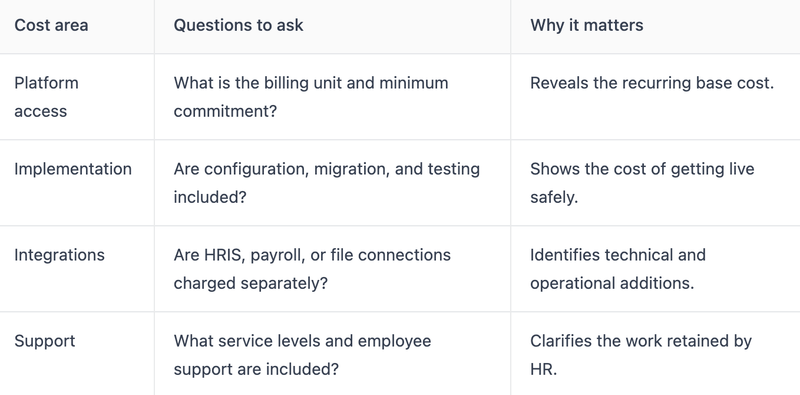
Use the table as a starting point, then model different workforce sizes and market mixes. The cheapest quote is not necessarily the lowest-cost operating model if it creates significant manual administration.
d. Planning for expansion beyond core APAC markets
A regional platform may be the best fit for an organization whose workforce and growth plans are concentrated in Asia-Pacific. A global platform may become more attractive when expansion into Europe, North America, or other regions is imminent. The key is to assess the next three years rather than buying for an abstract possibility.
Expansion planning should cover data portability, contract terms, support coverage, local implementation capacity, and whether new markets can be added without redesigning existing plans. It should also identify where a regional platform would remain valuable even after the organization adopts a broader global system.
6. Reviewing integrations, data, and security
Benefits platforms handle information that can be operationally sensitive and, in some cases, health-related. Integration quality affects accuracy, while data governance affects trust and risk. Procurement teams should involve HR technology, security, privacy, payroll, and legal stakeholders early. A polished user interface cannot compensate for unclear data flows or weak controls.
a. Connecting with HRIS and payroll systems
Start with the systems already treated as authoritative. Determine where employee identity, employment status, eligibility, salary-related fields, and benefit selections originate. Then document how changes move between systems, how often they are synchronized, and how failed transfers are identified.
A good integration review includes joiners, leavers, transfers, corrections, retroactive changes, and duplicate records. These ordinary cases often reveal more about operational reliability than a standard product demonstration.
b. Managing employee and benefits data
Data management should cover collection, validation, access, retention, correction, export, and deletion. Ask whether administrators can limit access by role, country, entity, or benefit type. Also confirm how the platform distinguishes employee data from claims, spending, provider, and reporting data.
Clear ownership is essential. HR may own plan configuration, payroll may own deductions, finance may own budgets, and security may oversee access controls. The platform should support those boundaries rather than encouraging broad, unnecessary access.
c. Evaluating privacy and security controls
Review documented security and privacy controls rather than relying on general assurances. Relevant questions include how data is encrypted, where it is stored, how vendors are assessed, how incidents are handled, and whether independent testing is performed. For Hong Kong employers, privacy expectations should be considered alongside the organization's own legal and governance requirements.
Security should also be evaluated operationally. Understand administrator authentication, access reviews, audit logs, backup practices, and business continuity arrangements. These controls are most useful when they are documented, tested, and connected to a clear incident process.
d. Assessing reporting and analytics capabilities
Reporting should support decisions, not merely reproduce transactions. Look for views of participation, utilization, spending, eligibility, exceptions, and trends by country or employee group. Confirm whether reports can be scheduled, filtered, exported, and reconciled with payroll or finance records.
Analytics should be interpreted carefully. High utilization may reflect strong relevance, but it may also reflect a narrow group of frequent users. Low utilization may point to weak communication or limited access. Context is what makes reporting useful.
7. Choosing the right platform for your organization
The best choice is the platform that fits the organization's actual workforce, operating model, and growth path. That may be an APAC-native platform, a global platform, or a combination of tools with clearly defined ownership. The decision should be evidence-based and tested with real employee and administrator scenarios. A structured process also makes it easier to explain the recommendation to finance, security, leadership, and local HR teams.
a. Matching platform capabilities to workforce needs
Begin with the workforce rather than the vendor category. Map employee locations, legal entities, benefit types, payroll systems, languages, currencies, provider relationships, and expected growth. Then separate must-have controls from desirable enhancements.
For a Hong Kong-centered employer, local healthcare access, transparent utilization, configurable benefits, and manageable administration may carry more weight than worldwide coverage. For a highly distributed multinational, governance and cross-border consistency may matter more. The answer depends on the shape of the workforce.
b. Building a weighted vendor scorecard
A scorecard makes trade-offs visible. Weight the categories according to business priorities, and require evidence for each score rather than relying on presentation quality. Include local HR and employee representatives where possible, since their experience can reveal practical friction early.
Useful categories include:
- Regional coverage and depth in priority markets.
- Compliance workflows, documentation, and accountability.
- Payroll, HRIS, data, and reporting integrations.
- Employee experience, access, language, and adoption support.
- Total cost, implementation effort, scalability, and service model.
After scoring, review the gaps rather than only the total. A platform with a high overall score may still be unsuitable if it fails a critical payroll, privacy, or country-coverage requirement. Weighting should guide judgment, not replace it.
c. Questions to ask during product demos
Ask vendors to demonstrate the work your teams will actually perform. Use a new hire, a leaver, a country transfer, a payroll correction, a benefit change, and an employee support request as test cases. Request written clarification where the demo depends on configuration or third parties.
The most revealing questions are often operational: Who owns the data? What happens when synchronization fails? Which reports are available without professional services? How are local changes communicated? What does the employee see when a benefit is unavailable in their market?
d. Recognizing when a hybrid approach makes sense
A hybrid model can be appropriate when a global employer needs central governance but has concentrated APAC requirements that a single worldwide system cannot address well. It can also make sense when existing payroll or HR systems are difficult to replace and a regional benefits layer can sit alongside them.
The risk is creating another fragmented environment. Define the system of record, integration points, support responsibilities, reporting standards, and employee communication model before adopting a hybrid approach. If those boundaries are clear, regional depth and global coordination can coexist without forcing every market into the same mold.
Conclusion
The choice between an APAC-native employee benefits platform and a global platform should follow the realities of your workforce, not a generic feature comparison. Evaluate local relevance, statutory processes, payroll connections, employee adoption, data controls, total cost, and future expansion together. A disciplined scorecard will show whether one platform or a carefully governed hybrid model can deliver benefits that employees understand and use.
Frequently Asked Questions
What is an APAC-native employee benefits platform?
It is a benefits platform designed around the regulatory, cultural, administrative, and employee-experience conditions of Asia-Pacific markets, with local variation treated as a core design consideration.
Are global benefits platforms suitable for APAC workforces?
They can be suitable when an organization values centralized administration and broad geographic consistency, but their country-level coverage, local workflows, provider access, and compliance support should be verified carefully.
What should HR evaluate first when comparing platforms?
Start with workforce locations, benefit categories, payroll and HRIS systems, local compliance needs, employee languages, currencies, and the amount of administration the team can realistically support.
How do local regulations affect platform selection?
Regulations influence eligibility, contributions, tax treatment, documentation, reporting, and data handling. A platform should support these processes, while the employer remains responsible for confirming its legal obligations.
Why does payroll integration matter for benefits?
Benefits changes can affect deductions, allowances, eligibility, and reporting. Reliable integration reduces duplicate entry and reconciliation work, while poor handoffs can create employee and payroll errors.
Is a hybrid benefits platform model practical?
It can be practical when global governance and regional depth are both necessary. The organization must define system ownership, integrations, support responsibilities, and reporting standards before combining platforms.
How can employers measure whether benefits are working?
Track enrollment, utilization, repeat usage, support requests, spending, employee feedback, and administrative exceptions by market. These measures together provide a clearer view than participation alone.
MixCare Health
MixCare Health · Hong Kong