
Want to make your employee benefits more relevant to your financial services team? Explore how MixCare Health’s healthcare, wellbeing and flexible benefits solutions can help Hong Kong employers create a more adaptable employee experience.
Key Takeaways
A competitive package combines reliable core protection with benefits that respond to different roles and stages of life. In Hong Kong, firms can make that offer more useful by reviewing what employees value and explaining the package clearly.
- Benefits sit alongside salary and bonuses as part of the overall employment offer.
- Core provisions can include MPF contributions, medical cover, insurance and leave above statutory entitlements.
- Wellbeing, family support and flexible options can make a package more relevant to different employees.
- Benefit design should reflect the demands of financial services work without treating every role alike.
- Regular benchmarking, employee feedback and clear communication help keep a package competitive and manageable.
1. How benefits shape competition for financial services talent
Financial services employers compete for people with a mix of technical knowledge, client skills and experience operating under regulatory and commercial pressure. Salary and bonuses matter, but they do not tell the whole story of what it is like to work for a firm. The wider package can influence whether a candidate accepts an offer and whether an employee can see a future there. For employers considering employee benefits for financial services Hong Kong, the practical question is which benefits employees can understand, access and value.
a. What employees expect beyond base salary and bonuses
Employees may look for reassurance as well as financial reward: medical protection, support for family needs, time away from work and help with health and wellbeing. Expectations vary, and an attractive benefit on paper may be less persuasive if eligibility or access is unclear. Benefits also shape the everyday experience of employment, especially when employees need support rather than another incentive. A package that is easy to explain and use can therefore carry weight beyond its headline value.
b. How benefits influence recruitment and retention
During recruitment, benefits help candidates compare the full offer, not just the salary figure. After someone joins, the same provisions can help build confidence that the employer takes health and personal needs seriously. They cannot replace good management, fair pay or a sustainable workload, but they can contribute to a more complete employment proposition. The key is to offer benefits that are relevant in practice and to make their terms visible before employees need them.
c. Why needs differ across junior, specialist and senior roles
A graduate may place particular value on clear medical cover and financial stability, while a specialist may prioritise development support or arrangements that fit a demanding work pattern. Senior employees may have different family, travel or health considerations. These are tendencies, not fixed rules: age, role and seniority do not reliably predict what an individual values. Employers can offer a consistent foundation while allowing employees to express different preferences where plan design permits.
d. How local and international employers compete for talent
Local and international firms may differ in their benefit traditions, plan structures and regional policies, but candidates in Hong Kong ultimately need to understand what applies to them in their location. A regional package may need local explanation, particularly where coverage, eligibility or leave differs between offices. Employers can stand out through clarity and relevance rather than assuming that a familiar global offer will suit every employee. That calls for regular review of local needs as well as consistency across the wider organisation.
2. Core benefits offered by financial services firms in Hong Kong
Core benefits provide a baseline of financial and health protection around the employment relationship. The details differ between employers, and statutory obligations should be distinguished from additional provisions offered by a firm. A clear explanation of both helps employees understand what is guaranteed and what forms part of the employer’s wider offer. This distinction is particularly useful when candidates compare packages or when employees join from another jurisdiction.

a. How employer MPF contributions fit into total rewards
Employer contributions to the Mandatory Provident Fund (MPF) are one part of an employee’s overall rewards, alongside salary, bonuses and other benefits. Employees may not experience this contribution as immediate spending money, so employers should explain it as part of longer-term financial provision. The specific obligations depend on the applicable rules and an employee’s circumstances; employers should check current requirements rather than rely on a general summary. A practical Hong Kong benefits guide can offer further background on statutory and optional provisions.
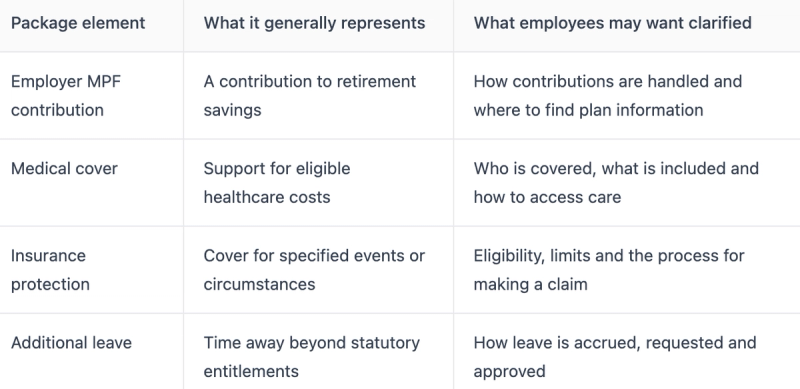
These categories are not interchangeable, and the table is a communication aid rather than a statement of any employer’s specific plan. Clear plan documents should set out the rules that apply to each provision.
b. What medical and hospital cover can include
Medical benefits may include different forms of treatment and hospital care, depending on the policy or employer plan. Employees need practical detail: who is eligible, whether dependants can be covered, what costs are included and which exclusions or limits apply. A benefit described simply as “medical cover” can leave too much open to interpretation. Employers should make access routes and points of contact easy to find, while avoiding promises that are broader than the policy terms.
c. How life, accident and disability insurance provide protection
Life, accident and disability cover address different risks and should be described separately. The circumstances covered, eligibility rules and benefit limits depend on the specific arrangement, so employees should be directed to the relevant policy documents. Clear explanations help people understand what protection exists and what steps they or their families may need to take. It is also sensible to review how these benefits interact with any other cover employees may have.
d. Where enhanced leave goes beyond statutory entitlements
Some employers offer annual leave or other time away beyond the statutory minimums that apply. The details may include additional leave days or provisions for particular circumstances, but the package and local rules determine what is available. Employers should state the difference between statutory entitlements and enhancements in plain language, including any approval or carry-over rules. Clarity here can prevent a well-intended benefit from becoming a source of uncertainty.
3. What leading firms offer beyond the basics
Once core cover is in place, employers can consider where additional support would be most meaningful. This need not mean adding every available perk: a focused set of options may be more useful than a long menu employees rarely use. Relevant additions can address everyday health, family responsibilities or personal choice. The best fit depends on workforce feedback, budget and the employer’s ability to administer the offer consistently.
a. How expanded medical cover can include outpatient and dental care
Employers may extend medical benefits to include outpatient services or dental care, subject to plan design and policy terms. These additions can make support more relevant to routine healthcare needs as well as major treatment, but employees need to know what is covered and how costs are handled. Waiting periods, annual limits, eligible providers and reimbursement processes can all affect the practical value of cover. A careful comparison of employee needs and plan conditions is more useful than relying on a broad benefit label.
b. Which wellbeing services support physical and mental health
Wellbeing support can span physical activity, mental health, nutrition and preventive care. MixCare Health Wellness Marketplace is a curated network of wellness providers, including fitness, mental health, nutrition and preventive care, accessible directly through the platform. Employers assessing any wellbeing offer should consider whether employees can find relevant services and understand how to access them. The workplace wellbeing resources can also inform a broader discussion about employee health and benefits strategy.
Wellbeing options are most useful when they connect to everyday needs rather than appear as a separate, unexplained perk. Employers can assess whether their offer provides:
- Straightforward information about available support and how to access it.
- Options that recognise both physical and mental wellbeing.
- A choice of services that can suit different preferences and circumstances.
- Regular opportunities to hear whether employees find the support relevant.
These checks help distinguish benefits employees can realistically use from offerings that exist only in a catalogue. They also give HR teams a practical basis for refining the programme over time.
c. How family-friendly benefits help employees at different life stages
Family needs can change over time, from childcare responsibilities to supporting older relatives or managing a new arrival. Employers may consider dependant cover, family-related leave or other forms of support, subject to policy terms and local requirements. The same provision will not matter equally to everyone, so clear choices can be more helpful than assumptions about who needs family support. Employers should also explain eligibility and application processes in a way employees can consult privately and easily.
d. What allowances and lifestyle perks can add to the package
Allowances and lifestyle benefits can give employees more choice about how they use a defined employer-funded amount. MixCare Health Flexible Spending Account (FSA) is a digital employee wallet funded by employers for spending on pre-approved health and wellness categories. Before introducing any allowance, employers should define eligible expenses, funding rules and approval processes so employees know what to expect. A benefit with clear boundaries can support choice while keeping administration and budget oversight more predictable.
4. How benefits address the demands of financial services work
Financial services roles can involve client deadlines, market-sensitive work, travel and periods of intense concentration. Benefits cannot remove those demands, and they should not be used as a substitute for sound workload management. They can, however, provide support around health, time away and personal circumstances. A thoughtful package recognises operational realities while avoiding the assumption that all teams work in the same way.

a. Support for high-pressure roles and employee wellbeing
High-pressure work makes accessible health and wellbeing support relevant, but the presence of a benefit alone does not establish a healthy working environment. Managers also need to notice workload patterns and make it possible for employees to seek support without stigma. Employers can explain available services and review whether employees can access them when they need to. The aim is practical support alongside good working practices, not a promise that benefits will eliminate stress.
b. Flexibility for teams with demanding or irregular schedules
Some teams work around client needs, reporting cycles or time-sensitive activity, which can make a single approach to flexibility difficult. Employers can set clear team expectations while considering options such as adjusted start times, planned time off or appropriate flexibility in how work is organised. The right arrangements depend on the role, client commitments and operational controls. Consistent communication helps employees understand what flexibility is possible and how decisions are made.
c. Benefits for internationally mobile employees and their families
Employees moving between locations may need clear information about local eligibility, coverage and the point at which one package gives way to another. Families relocating with an employee may also need guidance on access to healthcare and the terms of any dependant cover. Employers should coordinate local HR, mobility and benefits teams so that employees receive a coherent explanation before and after a move. This is especially important where regional policies and local requirements differ.
d. Role-specific support for front-office and specialist teams
Front-office teams and specialists can have distinct schedules, travel patterns or client-facing responsibilities, but their benefit needs should be established rather than assumed. Some support may be available across the organisation, while other arrangements may depend on role or location. It helps to explain any differences in eligibility openly and to review them for fairness and consistency. A package can recognise operational variation without making its underlying principles difficult to understand.
A useful review asks whether each group can access the support that is relevant to its work, and whether the rules are applied consistently. Where the answer is unclear, employee feedback and manager input can reveal where better communication or a plan adjustment is needed.
5. Why firms invest in competitive benefits
Benefits represent an investment in the conditions that help people join, stay and do their work. The case for that investment is not simply that a larger package is always better: cost, relevance and ease of access all matter. Employers can assess how benefits support workforce needs alongside other factors such as pay, management and career development. Treating benefits as part of the broader employment experience makes the rationale more practical and measurable.
a. Improving retention in a competitive talent market
When employees compare opportunities, a useful and understandable benefits package can strengthen the overall offer. It may also support retention by giving employees a reason to value the practical support available to them. That effect is not automatic; poor management, unclear progression or an unmanageable workload can outweigh generous cover. Employers should look at benefits alongside exit feedback and other workforce signals rather than treating them as a stand-alone retention fix.
b. Supporting sustainable performance and employee health
Health support and appropriate time away can contribute to employees being better placed to sustain demanding work over time. The employer’s responsibility is broader than offering a benefit: workloads, management behaviour and access to support all shape whether the working environment is sustainable. Benefits can form one part of a wider approach to employee health. Reviewing participation and feedback can help indicate where the package is useful and where barriers remain.
c. Strengthening employer reputation and employee engagement
Employees notice whether a stated benefit is understandable and available when needed. A well-explained package can reinforce an employer’s reputation as an organisation that takes people’s needs seriously. Engagement also depends on trust: employees should be able to see the terms, know where to ask questions and understand how their feedback is considered. Reliable communication is often as important as adding another item to the benefits list.
d. Managing workforce expectations across generations
Workforces include people with different financial commitments, family circumstances and preferences for support. It is risky to assume that a generation has a single set of priorities; direct feedback offers a better guide. Some employers make room for choice within defined categories, while retaining a common foundation for everyone. The challenge is to offer flexibility without making the package so complex that employees cannot understand its value.
6. How to assess and design a competitive benefits package
Designing a package starts with a clear account of the workforce, existing provisions and the outcomes the employer wants to support. Benchmarking can help identify gaps, but copying another firm’s offer may not suit a different role mix or budget. Employers also need to consider how easily people can understand and access the benefits. A regular review can keep the package aligned with employee needs and changes in the business.
a. Benchmarking against Hong Kong’s financial services market
Market comparisons can help employers understand common provisions and how their overall offer is positioned. A useful benchmark should compare like with like, taking account of workforce size, role mix, location and the scope of each benefit. It is also worth separating statutory requirements from discretionary enhancements so that comparisons do not blur the two. Use benchmarks as a reference point, then test whether the findings match the needs of the organisation’s own employees.
b. Using employee feedback to identify meaningful benefits
Employee feedback can reveal which provisions are valued, where access is confusing and what support people feel is missing. A combination of confidential surveys, focus groups and questions during benefit reviews can provide a fuller picture than a single annual poll. Employers should explain how feedback will be used and report back on decisions, including when a requested change is not feasible. This closes the loop and encourages more useful participation over time.
c. Balancing coverage, cost and ease of administration
A benefit should be assessed for its value to employees, cost to the organisation and administrative demands. These factors can be considered together rather than as separate decisions:
- Confirm the employee need the benefit is intended to address.
- Check eligibility, coverage limits and any relevant local requirements.
- Estimate costs and the work required to administer the benefit.
- Test whether employees can understand and access it without undue friction.
This sequence helps decision-makers compare options on more than their headline appeal. It also makes trade-offs visible, so the employer can explain why a particular package has been chosen and where it may need further review.
d. Communicating benefits clearly and reviewing them regularly
Employees need concise information on what is offered, who qualifies, how to use each benefit and where to ask questions. A central guide can make the package easier to navigate, while reminders at relevant moments can help employees find support when circumstances change. Employers should review the information as well as the benefits themselves, since outdated instructions can undermine a sound plan. Regularly checking employee feedback, use and administrative issues supports timely adjustments without assuming that one annual redesign is always necessary.
Conclusion
Competitive benefits for financial services employees in Hong Kong combine a sound foundation with support that reflects the realities of different roles and personal circumstances. Employers can make that support more effective by distinguishing statutory provisions from enhancements, inviting employee feedback and communicating access clearly. The strongest package is not necessarily the longest; it is one that people understand, can use and find relevant.
Frequently Asked Questions
What benefits are common in Hong Kong financial services?
Packages may include MPF contributions, medical cover, insurance and leave, with optional provisions such as outpatient or dental care, wellbeing support and family-related benefits. The details vary by employer and plan.
Are employer MPF contributions part of total rewards?
Yes. They can be considered alongside salary, bonuses and other provisions when employees assess the overall employment offer. Employers should explain how contributions fit within the applicable requirements and plan information.
Do employers have to provide medical insurance?
Medical insurance is often an employer-provided benefit, but the specific package and any obligations depend on applicable rules and employment arrangements. Employees should check their employer’s plan documents for coverage details.
What is the difference between statutory leave and enhanced leave?
Statutory leave refers to entitlements set by applicable employment rules. Enhanced leave is additional time or provision an employer chooses to offer, with its own eligibility and usage terms.
How can employers make benefits useful to different employees?
They can maintain a clear core offer, gather feedback from different employee groups and provide choices where practical. Straightforward information about eligibility and access also helps employees make use of what is available.
Should wellbeing benefits replace workload changes?
No. Wellbeing services can complement healthy working practices, but they do not substitute for sustainable workloads, supportive management or appropriate time away from work.
How often should a benefits package be reviewed?
Employers can review it regularly, using changes in workforce needs, employee feedback, costs and administrative issues as prompts. The timing should allow enough time to assess the package and communicate any changes clearly.
MixCare Health
MixCare Health · Hong Kong