
One benefits package rarely suits every employee. A flexible spending account (FSA) fixes this. You set a benefits budget, and employees spend it on approved items that matter to them. This flexible spending account Hong Kong guide explains how FSAs work, what to include, how to design your plan, and what to check on tax, MPF and privacy before launch.
Key Takeaways
A flexible spending account can give employees more say in how an employer-funded benefits budget is used. Its value depends on clear rules, relevant choices and careful administration.
- Set out the allowance, eligible expenses and claim process before enrolment begins.
- Offer categories that reflect different employee needs, rather than assuming one package suits everyone.
- Decide how unused balances will be treated and explain the rule in advance.
- Review Hong Kong tax, employment, MPF and privacy implications with appropriate advisers.
- Monitor use and employee feedback, then adjust the plan as needs and budgets change.
1. What a flexible spending account is and how it works
A flexible spending account is an employer-defined allowance that employees can use towards approved benefits. The plan rules determine how much is available, what expenses qualify and how employees access the funds. For a flexible spending account Hong Kong employer teams should treat it as a designed benefits arrangement and check the local implications rather than assume a particular legal or tax treatment.
a. How employees access a set benefits allowance
The employer sets an allowance for each eligible employee, either for a defined period or under another documented schedule. Employees then spend or claim against that balance, subject to the plan’s categories, limits and evidence requirements. MixCare Health offers a digital employee wallet that employers fund for pre-approved health and wellness categories; employers can create FSA wallets for healthcare, wellness and lifestyle benefits and configure funding, eligible expenses and rollover rules.
The experience depends on how the allowance is delivered. For example, an employer might make the available balance visible to employees, while claims are checked against the rules before payment or reimbursement. A clear statement of the balance and eligible uses helps employees understand what they can actually access.
b. The difference between a flexible spending account and a fixed benefits package
A fixed package gives employees a set collection of benefits, whether or not each item suits their circumstances. A flexible account instead places a defined amount behind a range of permitted options, so employees can direct some spending towards the categories that matter to them. It does not necessarily mean every benefit is interchangeable: employers may still set boundaries, caps and conditions.
That distinction affects both the employee experience and the plan’s administration. A fixed package may be simpler to explain, while a flexible arrangement requires employees to make choices and employers to define and communicate those choices well. A flexible benefits programme can also allocate credits across a menu of employer-defined options, though the exact design depends on the plan.
c. Employer-funded, employee-funded and shared funding models
Many workplace accounts are funded by the employer, with a stated allowance available to eligible employees. Some plans may allow employee contributions, or combine employee and employer funding, but the permitted arrangements and payroll handling should be checked before launch. The funding model should be written in plain terms so people know whether the allowance is additional to salary, conditional, or subject to a contribution.
Employers should also define what happens when an employee joins or leaves part-way through a plan period, and whether funding is made all at once or in instalments. These choices affect the budget and the balance employees see, so they belong in the plan rules rather than being left to informal practice.
d. How reimbursement, payment cards and direct billing can work
An account can be administered through reimbursement, a payment method linked to approved spending, or direct billing arrangements with participating providers. Each route has different practical requirements: reimbursement needs a claim and supporting evidence, while direct billing depends on provider arrangements and clear eligibility checks. The employer should choose a process that suits the categories on offer and the level of control it needs.
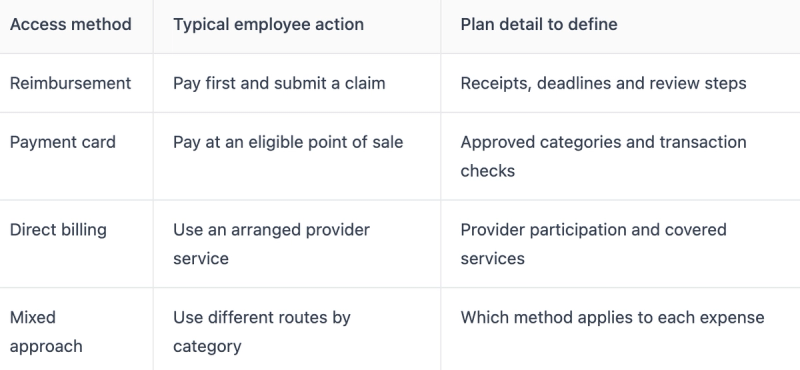
These are design options, not a guarantee that every provider or expense can be handled in every way. Matching the method to the benefit category helps avoid confusion at the point of use.
2. Why Hong Kong employers offer flexible spending accounts
Employers may use a flexible account to make a benefits budget more responsive to the people it is meant to support. The arrangement can create choice without requiring every employee to receive the same mix of benefits. It also asks the employer to make deliberate decisions about funding, eligibility and administration, rather than treating flexibility as a substitute for plan design.

a. Giving employees more choice over their benefits
Employees may value different things at different times, even when they work for the same organisation. An allowance that can be directed across approved categories gives people some discretion while retaining an employer-set budget and defined boundaries. The choice is meaningful only if the available options are easy to understand and practical to use.
Employers should make the distinction between choice and unrestricted spending explicit. A plan can offer a broad menu while still using category limits, approval rules or provider conditions to keep spending aligned with its purpose.
b. Supporting different life stages and personal needs
A workforce is rarely uniform: one employee may prioritise dental care, another may value fitness support, and someone else may need help with family-related costs. A flexible structure can accommodate this variation when the eligible categories have been chosen with the workforce in mind. It should not assume that every employee has the same access to providers or the same need for each benefit.
MixCare Health’s Wellness Marketplace is a curated network of wellness providers in areas including fitness, mental health, nutrition and preventive care, accessible through the platform. Employers considering a marketplace approach can assess whether the provider options and categories suit their own workforce and plan rules.
c. Using benefits budgets more strategically
A defined allowance gives employers a clearer framework for setting a maximum budget, while usage information can help show which categories employees choose. The data is useful when interpreted alongside workforce feedback and plan design; low use may reflect a poor fit, access barriers or unclear communication, rather than a lack of need. Employers should decide what information they will review and how it will inform future changes.
For Hong Kong-focused workforce decisions, the employee benefits guidance offers further reading on benefits, wellbeing, compliance and healthcare costs. Such material can help frame questions for internal review, but it does not replace advice on a specific employer’s circumstances.
d. Potential trade-offs, including administration and unused funds
Flexibility brings choices that a fixed package may not require. Someone must define eligible expenses, review claims, answer employee questions and keep the rules current. The employer also needs a clear position on unused funds, including whether they expire, roll over or are handled another way.
A workable plan usually considers several practical checks before launch:
- Whether employees can understand the eligible categories without repeated clarification.
- How claims and supporting documents will be reviewed, and within what timeframe.
- What happens to unused balances at the end of the plan period.
- Who handles exceptions, disputes and employee questions.
These decisions shape the day-to-day experience as much as the allowance itself. Simpler rules may reduce friction, while more choices can make the plan more relevant; employers need to balance the two.
3. What to include in a flexible spending account
The categories in an account should follow the employer’s objectives, workforce needs and available budget. A longer menu is not automatically a better one: employees need to recognise the options, and administrators need to apply the rules consistently. Employers should state which expenses are eligible, what evidence is needed and whether any sub-limits apply.
a. Health, dental and vision expenses
Medical, dental and vision costs are common areas for employers to consider, but the plan should spell out exactly what it covers. A category might include specified consultations or services, subject to a limit or supporting documentation. Employers should avoid relying on a broad label such as “healthcare” when the actual rules distinguish between types of provider or expense.
If employees also have other medical cover, explain how the account relates to it and whether the same expense can be claimed elsewhere. Clear coordination rules help reduce duplicate claims and make the account easier to use.
b. Wellbeing, fitness and mental health support
Wellbeing options can include fitness, mental health support, nutrition or preventive care, depending on the employer’s chosen scope. A plan should distinguish between eligible services and items that merely sound wellness-related; otherwise employees may make assumptions that the administrator cannot honour. Consider whether access is practical across the workforce, including for employees who work remotely or in different parts of Hong Kong.
When a provider network is part of the design, check its service range and the way employees find and use providers. MixCare Health Wellness Marketplace provides a curated network of wellness providers covering fitness, mental health, nutrition and preventive care, accessible through the MixCare platform.
c. Family, childcare and caregiving costs
Family and caregiving expenses may be relevant to employees with children or other care responsibilities. If an employer includes these costs, it should define which services qualify, who can use them and what proof is required. Eligibility rules should be clear enough to apply consistently without asking employees to disclose more personal information than necessary.
These benefits can be sensitive and vary widely between households. Reviewing proposed categories with employees, while protecting individual privacy, can help identify whether the offering is useful and understandable.
d. Learning, transport and lifestyle benefits
Employers may consider learning, transport or other lifestyle categories where these fit their benefits objectives and workforce. Each category needs a sensible boundary: for example, what types of learning count, or which transport costs are included. If a category is too vague, employees may interpret it differently from the administrator.
It can be helpful to start with a smaller set of well-defined options, then review employee feedback and usage before expanding. This keeps the plan manageable while giving the employer evidence about which choices are worth retaining.
e. Setting eligible expenses and spending limits
An eligibility schedule should describe each category, any exclusions, evidence requirements and the relevant spending cap. Employers can also specify whether limits apply per employee, per category or across the full allowance. Clear eligibility rules make decisions easier for employees and administrators alike.
A practical schedule might organise the details in a simple way:
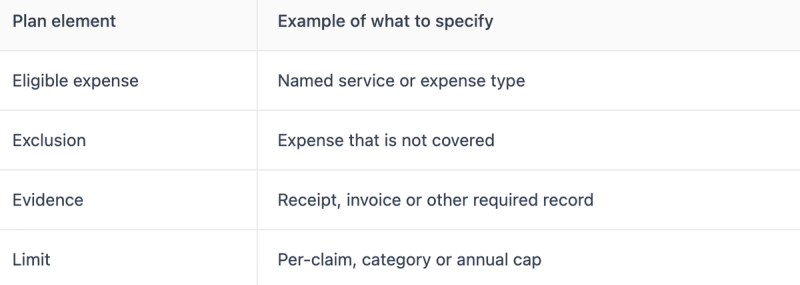
The wording should be tested against likely employee questions before it is published. If a rule is difficult to explain in one or two sentences, it may need greater precision or a simpler design.
4. How to design a plan for your workforce
Plan design starts with the purpose of the benefit, not the technology used to administer it. Employers should decide which employee groups the account is intended to support and how much choice they can manage within the available budget. A well-documented design gives HR, finance and employees a shared reference point.

a. Choosing who is eligible and when they can enrol
Define the groups covered by the plan and the date on which eligibility begins. Employers may need different rules for new starters, part-time employees or employees changing roles, depending on their workforce and policies. These decisions should be checked against applicable employment terms and local requirements before implementation.
Enrolment windows also need a clear purpose. An annual selection period may suit a plan with a fixed yearly allowance, while other arrangements may need to address changes in employment or personal circumstances. Whatever the approach, tell employees when choices open and when they take effect.
b. Setting allowances, contribution rules and annual limits
Set the total budget before deciding how it is divided among categories. The plan should explain whether every employee receives the same allowance or whether amounts vary by a documented factor, and whether any employee contribution is permitted. Annual or category limits should be visible to employees before they make selections or submit claims.
Finance and HR should agree how balances are recorded and how adjustments are made when an employee joins or leaves during a plan period. Consistent rules reduce the risk of different teams giving different answers about the same allowance.
c. Deciding whether unused balances roll over or expire
Unused balances can expire, roll over subject to conditions, or follow another rule set by the employer. Each option has implications for budgeting and employee expectations, so the choice should be made before the plan is announced. The rule should also say when a balance is calculated and what happens at the end of employment or the plan year.
Employers should avoid relying on an informal assumption that employees will know what happens to unused funds. A short, prominent explanation at enrolment and in the claims guidance can prevent avoidable surprises.
d. Offering benefit choices that reflect employee needs
Gathering employee input can help employers identify which categories are relevant and where access may be difficult. Surveys, existing benefits questions and workforce discussions can each provide useful signals, but responses should be interpreted alongside the organisation’s goals and budget. The aim is not to include every requested item; it is to select a coherent set of options employees can understand and use.
A centralised wellbeing resource can support communication around the wider programme. MixCare Health Wellness Hub provides wellbeing content and engagement, including health education, mental wellness resources and wellbeing challenges through the platform.
e. Checking provider networks and service access across Hong Kong
A benefit may look useful on paper but be hard to access if the relevant providers are not convenient for employees. Review service locations, appointment routes, language needs and any other practical barriers that matter to the workforce. Where an account relies on a provider network, confirm how employees can check participating services and what happens if they use a provider outside it.
Access should be assessed across the workforce rather than from the perspective of a central office alone. That makes it easier to spot gaps for employees in different districts or working patterns before the plan goes live.
5. Hong Kong tax, employment and MPF considerations
An employer-designed spending account should be reviewed in the context of Hong Kong’s tax and employment framework before it is launched. The treatment can depend on the precise arrangement, the payment route and the facts of each case, so general descriptions are not a substitute for professional advice. It is sensible to involve HR, payroll, finance and advisers early enough to resolve questions before employee communications are issued.
a. Reviewing how benefits may be treated for salaries tax
Do not assume that an allowance, reimbursement or direct payment has the same salaries tax treatment in every case. Ask a qualified Hong Kong tax adviser to review the structure, the documents and how the benefit is delivered. Employers should also decide who is responsible for keeping records that support payroll and tax processes.
For a broader orientation to local benefits topics, employers can consult this Hong Kong benefits guide, then verify any tax question against current official guidance or specialist advice. The account’s written rules should match the actual process used to fund and pay claims.
b. Checking whether contributions affect MPF calculations
The relationship between a benefit arrangement and MPF calculations depends on its specific structure and applicable rules. Employers should confirm with payroll or an MPF adviser whether any payments or contributions need to be considered, and how they should be recorded. Avoid assuming that calling a payment a “benefit” determines its treatment.
Document the conclusion and revisit it if the funding model or payment process changes. A clear record can help keep plan administration aligned with payroll practice.
c. Aligning plan rules with employment contracts and company policies
Review the account rules against employment contracts, staff handbooks and existing benefits policies. The documents should be consistent about eligibility, funding, changes to the plan and the treatment of balances. If a benefit is discretionary or subject to amendment, that should be explained accurately and in a way that has been checked by the employer’s advisers.
Employees need to know which document governs if two sources appear to differ. A single, maintained set of plan rules can reduce uncertainty for both employees and HR teams.
d. Protecting employee data and handling claims confidentially
Claims may reveal sensitive details about an employee’s health or family circumstances. Limit access to information to people who need it for administration, define secure handling and retention processes, and explain how personal data is used. Employers should review the relevant privacy obligations and any service-provider arrangements before collecting claims information.
Confidentiality should be part of the operating process, not just a statement in the employee guide. Staff handling claims need clear instructions on access, escalation and secure record keeping.
6. How to launch and manage the account
A successful launch depends on coherent rules, a workable claims process and straightforward employee communication. Employers should test the plan from the employee’s point of view as well as the administrator’s: can someone find the eligible expense, understand the remaining balance and know what to do if a claim is declined? A short pilot or structured review of the process can expose confusing steps before wider use.
a. Selecting a benefits administrator or platform
Compare potential administrators against the plan’s actual needs, including funding arrangements, eligible categories, reporting, employee access and support. Ask how rules are configured, how changes are recorded and what information is available to the employer. Data security, privacy responsibilities and service arrangements should be considered alongside ease of use.
The right choice is the one that supports the agreed operating model rather than adding features the employer does not need. Clarify responsibilities between the employer and administrator before any employee data or funds are transferred.
b. Defining claims, approval and reimbursement processes
Write down the steps from submission to decision and, where relevant, reimbursement. Employees should know what evidence to provide, how long a review is expected to take, and where to ask about an unclear decision. Administrators need an escalation route for exceptions and a consistent way to apply the eligibility rules.
Employers should test representative claims before launch, including a straightforward eligible expense and a case that falls outside the rules. This helps confirm that written policy, approval steps and employee messages are aligned.
c. Explaining choices, deadlines and eligible expenses to employees
Employees need a concise explanation of the allowance, the available categories, how to access it and the dates that matter. Use examples to clarify the rules, while making clear that examples do not extend eligibility beyond the written plan. A frequently asked questions page or staff briefing can help address common points without making the underlying rules harder to find.
Communications should also explain how to check a balance and what happens if a claim is incomplete or ineligible. MixCare Health Wellness Hub provides a centralised place for wellbeing content and engagement through health education, mental wellness resources and wellbeing challenges; employers can consider how such resources fit into their wider employee communications.
d. Reviewing usage, feedback and costs to improve the plan
Set a review rhythm before launch, then compare usage and costs with the plan’s objectives. Look at which categories are used, where claims encounter friction and whether employees understand the rules. Usage data can guide questions, but it should be interpreted carefully and handled in line with privacy requirements.
Gather employee feedback and consider adjustments to categories, limits or communications at a defined review point. Any changes should be documented and explained before they take effect, so employees can make informed choices under the updated rules.
Conclusion
A flexible spending account can help Hong Kong employers offer a defined benefits budget with meaningful employee choice, provided the plan is designed around real needs and administered with care. Clear eligibility rules, workable claims processes and early review of tax, employment, MPF and privacy questions give the arrangement a sound foundation. Regularly reviewing usage and feedback helps employers keep the account useful as their workforce changes.
Frequently Asked Questions
What is a flexible spending account?
It is an employer-defined benefits allowance that employees can use for expenses approved under the plan’s rules. The employer sets the funding, eligible categories, limits and access process.
How is a flexible spending account different from a fixed benefits package?
A fixed package provides a set collection of benefits, while a flexible spending account gives employees an allowance to direct across specified options. The employer still determines the choices and conditions available.
Who funds a flexible spending account?
Many workplace arrangements are employer-funded, though some may include employee contributions or shared funding. The exact approach should be documented and checked for payroll and legal implications.
What expenses can be included?
Possible categories include healthcare, dental and vision services, wellbeing, fitness, family care, learning or transport. Employers should define the eligible expenses and exclusions rather than rely on broad category names alone.
Do unused balances roll over?
That depends on the plan. An employer may allow a rollover, set conditions or have balances expire, and should explain the rule before employees enrol.
Are flexible spending accounts taxable in Hong Kong?
Tax treatment depends on the structure and circumstances of the benefit. Employers should seek current advice from a qualified Hong Kong tax professional rather than assume a single treatment applies to every arrangement.
How can employers make an account easier to use?
Publish clear eligibility rules, explain claim steps and deadlines, and make balances and decisions easy for employees to understand. Reviewing questions, usage and feedback can reveal where the process needs improvement.
MixCare Health
MixCare Health · Hong Kong