
Workplace mental health support in Hong Kong is becoming increasingly important as employers recognise the impact of employee wellbeing on engagement, productivity and retention. From managing workplace stress and preventing burnout to providing access to professional mental health services, organisations need practical strategies that address employees’ psychological wellbeing. This guide explores how Hong Kong employers can build a healthier workplace through mental health benefits, supportive leadership, employee assistance programmes and effective wellbeing initiatives.
Key Takeaways
A mentally healthier workplace is built through practical systems, not occasional campaigns. Hong Kong employers can make progress by listening carefully, widening access to support, and protecting employee trust.
- Assess workload, culture, and psychosocial risks across teams.
- Offer confidential support through more than one access route.
- Train managers to respond with empathy without diagnosing.
- Set clear privacy, escalation, and return-to-work processes.
- Measure access and experience, then improve the program steadily.
1. Understand the case for workplace mental health support in Hong Kong
Workplace mental health support Hong Kong employers provide should reflect the realities of local working life, including demanding schedules, dense urban routines, and varied family responsibilities. A useful program is not only a response to distress; it also helps people stay well before problems become severe. Employers should treat mental health as part of everyday workforce planning, alongside physical safety and benefits administration.
a. Common mental health challenges affecting Hong Kong employees
Employees may experience anxiety, low mood, insomnia, burnout, loneliness, or difficulty concentrating. These concerns do not always look dramatic at work: someone may become quieter, miss deadlines, take more sick leave, or stop joining conversations. Stigma can also make people cautious about disclosure, which is why visible support should be paired with private routes to help.
Hong Kong employers can use Hong Kong workplace mental health research to inform their assessment, while remembering that organization-wide findings do not diagnose individuals. The aim is to understand patterns and remove barriers, not to label employees.
b. How stress, long hours, and job insecurity influence wellbeing
Stress becomes more difficult to manage when long hours, unpredictable demands, financial concerns, or job insecurity continue without recovery time. Caregiving duties and limited control over schedules may add pressure, particularly for employees balancing office work with responsibilities at home. A thoughtful response examines how work is organized instead of treating resilience as an individual obligation.
Managers should look at workload peaks, staffing levels, meeting habits, and the practical ability to take breaks. Small operational changes, such as clearer priorities and earlier notice of schedule changes, can make support more credible than a message encouraging people simply to cope better.
c. The business impact of untreated mental health concerns
Untreated concerns can affect concentration, attendance, collaboration, retention, and decision-making. They may also increase pressure on colleagues, who absorb unfinished work and become less willing to speak openly themselves. The result is often gradual: a team loses energy and trust before leaders recognize the underlying issue.
For employers considering MixCare Health, benefits design can be one part of a wider response. Its documented focus includes configurable employee benefit programs, analytics, compliance, and HR integration; those capabilities can support a broader benefits framework, but they do not replace clinical care or responsible management.
2. Assess your organization’s current mental health needs
Assessment should precede procurement. Start by learning where employees encounter pressure, which support they already trust, and what prevents them from using available services. Combine quantitative information with careful listening, and communicate what the organization will and will not do with the findings.
a. Use anonymous surveys and listening sessions responsibly
Anonymous surveys can identify themes around workload, psychological safety, access, and awareness of benefits. Keep questions proportionate, avoid collecting unnecessary personal details, and report results only where group sizes protect anonymity. Listening sessions add context, but participation must be voluntary and facilitated in a way that does not expose individual experiences to supervisors.
Before launching, explain the purpose, data retention period, reporting method, and available support if a question raises concern. Trust begins before the first question: employees need evidence that feedback will lead to action rather than surveillance.
b. Identify psychosocial risks across roles and teams
Risk is rarely distributed evenly. A customer-facing team may face emotional labor, a finance team may experience intense closing cycles, and frontline or shift workers may struggle with access to daytime services. Review job design, staffing, autonomy, manager behavior, conflict patterns, and exposure to distressing situations.
A practical risk review can organize observations in a simple working table:
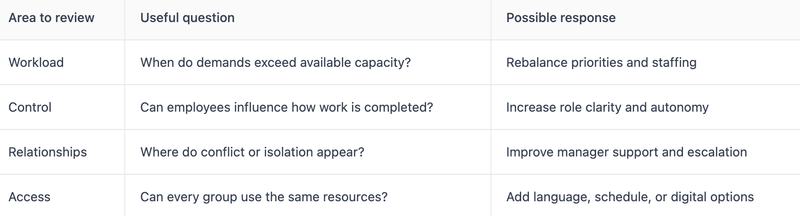
The table is a starting point, not a scorecard for individual employees. Review patterns with HR, legal, and operational leaders, then agree which risks require immediate action and which can be addressed through longer-term planning.
c. Segment support by workforce needs and accessibility
A single benefit rarely fits a workforce with different ages, roles, languages, locations, and comfort levels. Some employees may prefer a phone conversation, while others want digital self-service or a referral from a healthcare professional. Shift workers and remote employees may need support outside standard office hours.
Segmenting should improve access without revealing sensitive information. Offer several routes, publish them clearly, and check whether employees can use them without asking a manager for permission.
3. Build a practical workplace mental health strategy
A strategy turns good intentions into repeatable practice. It should connect prevention, early support, clinical referral, manager capability, and return-to-work arrangements. The document itself can be concise, provided ownership and decision points are clear.
a. Set clear goals, ownership, and internal policies
Begin with a small number of measurable goals, such as increasing awareness of available support, reducing barriers for shift workers, or improving confidence among people managers. Assign an executive sponsor, an operational owner, and clear responsibilities for HR, managers, benefits partners, and clinical providers.
Policies should cover respectful conduct, reasonable support, sick leave, accommodations, referrals, crisis escalation, and privacy. They should also explain what managers are expected to do when a concern is raised and what falls outside their role.
b. Combine prevention, early intervention, and recovery support
Prevention may include manageable workloads, psychologically safe team practices, education, and time for recovery. Early intervention adds confidential counseling, self-help resources, and straightforward referral routes. Recovery support focuses on adjustments, communication, and a gradual, dignified return when appropriate.
These layers work best together. An awareness workshop cannot compensate for chronic understaffing, and a counseling service cannot carry the full responsibility for an unhealthy work design.
c. Align programs with company culture and business operations
Support is more likely to be used when it fits the way people actually work. A high-volume operation may need short digital resources and flexible appointments, while a professional-services firm may need stronger boundaries around availability and workload peaks. Leaders should model the behavior they want to see by taking breaks, respecting leave, and discussing support without embarrassment.
Wellness activities can complement, but not substitute for, structural improvements. If an organization uses events, connect them to a wider plan and offer live or virtual access where appropriate. A program that is easy to join but difficult to trust will not create lasting value.
4. Provide accessible mental health resources for employees
Access is a design question as much as a budget question. Employees need to know what is available, how confidential it is, what it costs, and what happens after the first contact. Keep the information easy to find during ordinary working days, not only during a crisis.
a. Offer confidential counseling and employee assistance services
Counseling or an employee assistance service can provide an early, low-friction route for people who are unsure what kind of help they need. Employers should confirm provider qualifications, appointment availability, language coverage, and the limits of employer reporting. Communications should avoid implying that use of the service signals poor performance.
The Wellness Marketplace is described as a curated network of wellness providers, including mental health, nutrition, fitness, and preventive care services, with direct access through the platform. Employers still need to explain eligibility, privacy, and clinical boundaries clearly before presenting any marketplace as part of a wider support program.
b. Create referral pathways for professional and clinical care
A referral pathway should answer practical questions: who can provide an assessment, how quickly can an appointment be arranged, and what happens if a provider is unavailable? Include primary care, qualified mental health professionals, specialist care, and urgent services as appropriate to the organization and location.
Managers should not select a diagnosis or promise an outcome. Their role is to listen, share available options, help remove work barriers, and escalate immediate safety concerns according to policy.
c. Support different languages, schedules, and comfort levels
Hong Kong workplaces may include employees who prefer Cantonese, Mandarin, English, or another language. Services should also account for shift patterns, travel, disability access, digital confidence, and people who prefer not to speak with someone connected to their workplace.
A useful access plan usually includes several routes:
- A confidential phone or video appointment option.
- Clear digital information that works on mobile devices.
- In-person referrals where remote care is unsuitable.
- Plain-language materials in the main workforce languages.
After introducing these routes, test them with representative employees. Their experience will reveal barriers that a benefits brochure cannot show.
5. Equip managers to respond with confidence and empathy
Managers are often the first people to notice a change, but they are not clinicians. Their contribution is to create a safe conversation, respond consistently, and connect employees with appropriate support. Training should include practice, boundaries, documentation, and escalation rather than relying on a short awareness presentation.
a. Train managers to recognize potential warning signs
Potential warning signs include sustained changes in attendance, communication, work quality, mood, or interactions with colleagues. None of these proves a mental health condition, and managers should avoid drawing conclusions from a single incident. Training should help them notice patterns while considering ordinary explanations such as workload, illness, bereavement, or caregiving.
Teach managers to record relevant work facts, protect privacy, and consult HR when policy or safety questions arise. The goal is a humane response, not a diagnostic judgment.
b. Start supportive conversations without diagnosing employees
A useful opening is specific and non-judgmental: describe the work change, ask how the person is doing, and offer time to talk. Managers can ask what support would make work more manageable, then explain available resources. They should not demand personal details or press an employee to disclose a diagnosis.
Silence is not always a sign that everything is fine, but neither is every difficult day a crisis. A calm conversation gives the employee room to choose what to share and keeps the manager focused on practical support.
c. Handle workload adjustments, leave, and return-to-work plans
Adjustments may involve priorities, hours, deadlines, location, breaks, communication frequency, or temporary redistribution of tasks. Any plan should be specific, time-bound, and reviewed with the employee rather than imposed without discussion. HR and relevant professional advice may be needed where leave, disability, or legal obligations are involved.
A return-to-work plan should balance privacy with the information a team needs to operate. Agree on who communicates what, identify signs that the arrangement needs review, and avoid treating a return as proof that all difficulty has ended.
6. Protect employee privacy, dignity, and trust
People will use support only when they believe the consequences are safe. Privacy therefore belongs in program design, vendor selection, manager training, and communications. Employers should collect the least information necessary and make access rules understandable to ordinary employees.
a. Define confidentiality limits and information-sharing rules
Explain which information stays with a provider, which aggregated data may be shared with the employer, and when information may need to be disclosed for immediate safety or legal reasons. Contracts and internal procedures should address access controls, retention, security, and deletion. Where personal data is involved, obtain appropriate advice on Hong Kong privacy obligations.
Managers should never create informal lists of employees who seek help. Reports should use aggregated information only when group size and context prevent re-identification.
b. Avoid stigma, discrimination, and harmful workplace assumptions
Language shapes whether support feels safe. Avoid describing employees as unstable, difficult, or lacking commitment because they ask for help or need an adjustment. Performance conversations should remain grounded in observable work expectations, with support considered separately and fairly.
Leaders can reduce stigma by discussing mental health as one part of wellbeing, making resources available to everyone, and treating leave and accommodations consistently. Confidentiality also means not turning a personal disclosure into workplace gossip.
c. Manage urgent risks and mental health crises appropriately
A crisis may involve an immediate threat of harm, severe disorientation, or an inability to stay safe. Organizations should have a short escalation procedure that tells managers whom to contact, what information to share, and how to stay with the employee or arrange immediate assistance when appropriate.
Do not ask an untrained manager to handle a crisis alone. Emergency services and qualified clinical professionals should be used when immediate danger is present, while the organization maintains a calm, private, respectful response.
7. Measure and improve your mental health support program
Measurement should show whether support is reachable, trusted, and useful, not whether employees have disclosed private diagnoses. Combine service access information with anonymous feedback and operational indicators. Interpret trends carefully, since a rise in usage may indicate improved trust rather than worsening wellbeing.
a. Track participation, accessibility, and employee feedback
Track awareness, appointment availability, utilization by broad workforce segment, language access, wait times, and employee-reported experience. Avoid publishing small-group results that could identify a person. Ask whether employees know where to go, whether the process felt respectful, and what prevented access.
When a benefit platform is part of the wider program, operational visibility can help HR review engagement and administration. MixCare Health describes its Wellness Marketplace as providing real-time analytics, while employers remain responsible for using information proportionately and protecting personal privacy.
b. Monitor wellbeing indicators without compromising privacy
Useful indicators may include aggregated absence patterns, turnover, workload survey results, psychological safety scores, and manager confidence. These are signals, not proof of a clinical condition. Keep survey data separate from performance records and set access rules before collecting it.
A privacy review should ask whether each measure is necessary, who can see it, how long it is retained, and whether employees understand its purpose. That discipline protects both people and the credibility of the program.
c. Review outcomes and refine support over time
Set a regular review cycle, perhaps quarterly for operational data and annually for strategy. Compare results with the original goals, listen to employees who did not use the service, and examine whether support reached different roles and schedules. Document what changed and why.
For organizations seeking a configurable benefits approach, MixCare Health describes an ecosystem that includes flexible spending, wellness services, and benefits configuration. Such tools may simplify administration, but improvement still depends on thoughtful governance, human follow-up, and a willingness to change workplace conditions.
Conclusion
Workplace mental health support Hong Kong employers provide is strongest when it combines safer work design, confidential access, capable managers, privacy safeguards, and continuous review. Begin with listening, make support practical for different employees, and improve the program using evidence without turning wellbeing into surveillance.
Frequently Asked Questions
What should a Hong Kong employer do first to improve mental health support?
Start with a confidential assessment of workload, access barriers, psychological safety, and existing resources. Use the findings to set a small number of priorities with clear owners.
Should employers ask employees about diagnosed mental health conditions?
Usually, employers should avoid collecting diagnoses unless there is a clear, lawful, and necessary reason. Focus on work-related support needs, accommodations, and access to professional care.
How can managers support an employee without diagnosing them?
Managers can describe observable changes, ask how the employee is doing, listen without judgment, explain available resources, and involve HR or qualified professionals when policy or safety concerns arise.
What makes an employee assistance service trustworthy?
Employees need clear information about provider independence, confidentiality, data handling, costs, language access, appointment availability, and the limited circumstances in which information may be disclosed.
How should employers support shift workers?
Offer services outside standard office hours, mobile-friendly information, multiple communication channels, and arrangements that do not require employees to disclose personal matters to a direct supervisor.
How can a company measure whether its program works?
Track awareness, access, wait times, broad participation, employee experience, manager confidence, and relevant aggregate workforce indicators. Do not use private clinical information as a performance measure.
What should happen during a mental health crisis at work?
Follow a clear crisis procedure, prioritize immediate safety, contact qualified emergency or clinical support when necessary, and share only information needed for the response. Managers should not handle serious risk alone.
MixCare Health
MixCare Health · Hong Kong