
Looking for a health check Hong Kong residents can rely on? Choosing the right health screening package can help you understand what tests you actually need, what to expect, and how to prepare. This practical guide covers the key factors to consider when comparing health check packages in Hong Kong, from screening tests and costs to preparation and follow-up.
Key Takeaways
A well-chosen health screening is more useful when it matches your age, medical history, and reason for testing. The cheapest package is not always the most suitable one.
- Start with the purpose of the check, not the package name.
- Ask which tests are included and which may cost extra.
- Confirm fasting, medication, and document requirements before attending.
- Choose screening based on personal risk rather than a long list of tests.
- Review results with a qualified doctor and arrange follow-up where needed.
1. Understand what a health check in Hong Kong includes
A health check in Hong Kong can range from a short assessment with basic blood and urine tests to a more extensive program involving imaging and specialist review. Packages vary considerably, so the label alone does not tell you what you are buying. A sensible starting point is to identify your health concerns, family history, and the kind of follow-up you would want if a result were abnormal.
a. Common tests in standard screening packages
Most standard packages begin with a medical questionnaire, physical measurements, and a consultation or examination by a doctor. Blood pressure, body mass index, urine testing, blood counts, glucose, cholesterol, liver function, and kidney function are common components, although the exact panels differ. Some providers also include an electrocardiogram, chest imaging, stool testing, or vision checks.
Read the itemized list rather than relying on words such as “comprehensive.” A provider’s health screening services may explain practical details such as fasting, sample collection, and report handling, which can be just as important as the test list itself.
b. How age, sex, and medical history affect screening needs
Screening should reflect the person being screened. Age may affect the timing of certain checks, while sex, family history, smoking, alcohol use, weight, previous diagnoses, and medication can change which investigations deserve discussion. A test that is useful for someone with a strong family history may add little value for another person without that risk.
Tell the clinician about symptoms and prior abnormal results, even if they seem unrelated to the package. Screening is generally designed for people without symptoms; persistent or worrying symptoms may require a diagnostic consultation instead of waiting for a routine check.
c. The difference between basic, executive, and comprehensive checks
“Basic,” “executive,” and “comprehensive” are commercial labels rather than universal medical categories. A basic check may focus on measurements and common laboratory tests, while a higher-priced package can add cardiac assessments, imaging, cancer-related tests, or longer consultations. What matters is whether those additions are appropriate for your situation and whether a doctor will interpret them properly.
Use the package description to compare scope, not prestige. A smaller, relevant panel can be more useful than a long list of low-risk tests that creates incidental findings without a clear plan for what to do next.
d. When a doctor-led assessment is more suitable than a package
A doctor-led assessment may be preferable when you have symptoms, several chronic conditions, a complex family history, or uncertainty about which tests are appropriate. The clinician can decide whether a test is indicated, explain its limitations, and avoid unnecessary investigations. This approach is also helpful if you have received an abnormal result elsewhere and need a focused review.
A package can be a convenient starting point for preventive care, but it should not replace medical advice. Ask how results will be reviewed and whether referral or repeat testing is available if something needs attention.
2. Choose the right health screening provider
The provider affects more than the comfort of the appointment. It determines how clearly the scope is explained, how specimens and images are handled, and whether a qualified professional helps you understand the report. When comparing options for a health check in Hong Kong, consider clinical quality and continuity alongside location and price.
A calm process is useful, but convenience should not obscure the central question: who will interpret the findings and help you decide what happens next?

a. Comparing hospitals, private clinics, and specialist centres
Hospitals may offer access to multiple specialties and diagnostic departments, while private clinics can provide a more streamlined appointment experience. Specialist centres may focus on particular groups or screening needs. None is automatically the right choice; the best fit depends on the complexity of your health history, the tests required, and the level of follow-up you expect.
Check whether the advertised package is delivered at the stated location and whether outside referrals are needed for imaging or specialist review. It is also worth asking whether reports from different departments are combined into one doctor-led discussion.
b. Checking doctor qualifications and laboratory accreditation
Ask who conducts the examination and who reviews the final report. The provider should be able to explain the clinician’s role, the laboratory arrangements, and how samples are identified and transported. For tests performed by an external laboratory, clarity about the relationship is preferable to vague claims about quality.
Accreditation can support confidence in laboratory processes, but it does not make every test necessary for every person. You still need a clinician to relate the result to your symptoms, history, and overall risk.
c. Assessing equipment, facilities, and follow-up services
Facilities matter when a package includes imaging, cardiac testing, or procedures that require dedicated equipment. Look for clear information about where each test takes place, how results are delivered, and whether images or reports can be accessed later. Follow-up is especially important when the package includes tests that may produce findings requiring confirmation.
Before booking, ask these practical questions:
- Is a doctor available to explain the report?
- Are repeat tests or referrals arranged through the same provider?
- How are urgent or significantly abnormal findings communicated?
- Can I obtain copies of laboratory and imaging reports?
The answers reveal whether the service is built around a one-time transaction or an ongoing care pathway. A convenient appointment is useful, but a clear follow-up process protects its value.
d. Reviewing language support and appointment availability
Language support can affect whether you understand preparation instructions and the meaning of your results. Confirm which languages are available for registration, clinical consultation, and report explanation rather than assuming that support is consistent across the whole visit.
Appointment timing matters too. Ask about early-morning slots if fasting is required, expected waiting times, and how soon the report review can occur. If you need an attendance slip or specific documentation for work, clarify that before the appointment.
3. Compare health check packages and costs
Package prices can differ because of the number of tests, the type of equipment used, the seniority of the reviewing clinician, and the amount of follow-up included. A low headline price may exclude items you expected, while a costly package may contain investigations that are not relevant to you. Compare the full pathway from booking through report review.
a. What is usually included in the quoted price
A quotation may include registration, basic measurements, laboratory testing, a physical examination, and a written report. Some packages include a doctor consultation, while others charge separately for interpretation or referral. Ask whether sample collection, imaging, and report delivery are included, and whether tax or administrative fees change the advertised price.
A useful comparison is to place the main elements side by side before deciding:
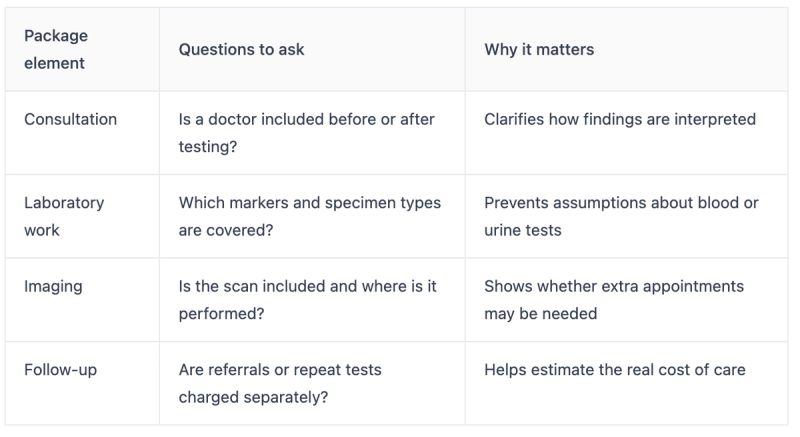
This simple comparison often exposes differences that are hidden by package names. It also gives you a practical list of questions for the booking team.
b. Tests that may cost extra
Additional imaging, specialist consultations, repeat laboratory work, and tests selected because of personal risk may not be part of the base price. Some services also charge for diagnostic procedures that follow an initial screening finding. Ask for an estimate before agreeing to an add-on, and confirm whether it is medically recommended or simply optional.
Cancer-related markers deserve particular caution. A marker is not automatically a screening test for everyone, and an isolated result may need clinical interpretation or confirmation. Discuss the purpose and limitations before paying for additional testing.
c. How to compare package value rather than price alone
Value comes from relevance, accuracy, explanation, and follow-up. A package is more useful when its tests answer sensible preventive questions and the provider explains what an abnormal result means. It is less useful when the list is long but the report offers little guidance.
Clear follow-up is part of value, not an optional extra. Consider the quality of the consultation, the reliability of the laboratory process, the convenience of returning for review, and the likelihood that you will act on the recommendations.
d. Using insurance, employer benefits, or company health programs
Some health checks are paid personally, while others may be supported by an employer, insurer, or company wellness program. Check eligibility, reimbursement limits, approved providers, and whether pre-authorization is required. Preventive screening may be treated differently from diagnostic care, so do not assume that a general medical benefit covers every package item.
For employers, the administrative model matters as much as the individual appointment. MixCare Health describes a self-funded outpatient program with AI-powered claims processing, cashless doctor visits, configurable stop-loss planning, and real-time data dashboards. That kind of benefits structure is separate from choosing a screening clinic, but it may help an organization manage broader outpatient costs with clearer visibility.
Employers planning recurring health activities can also consider MixCare Health, which documents coordination of wellness providers, scheduling, registration, and post-event reporting for activities covering fitness, mental health, nutrition, and preventive care. Any company program should still make participation voluntary where appropriate and protect personal medical information.
4. Prepare for your health check appointment
Preparation affects the quality and smoothness of the visit. A fasting mistake, incomplete medication information, or missing previous report can delay testing or make the results harder to interpret. Read the provider’s instructions carefully and contact the clinic if anything is unclear.

A little planning can reduce waiting and help the clinician see the full picture rather than one isolated set of results.
a. Fasting, medication, and other preparation requirements
Whether fasting is needed depends on the selected tests. Blood glucose and some other blood tests may require fasting, while other appointments do not. Ask exactly when to stop eating and drinking, whether plain water is allowed, and whether usual medication should be taken.
Do not stop prescription medication unless a qualified clinician tells you to do so. Also ask about exercise, alcohol, supplements, and the timing of urine or stool samples if they are included. Written instructions are preferable because verbal advice can be misremembered.
b. Documents and previous medical records to bring
Bring identification, booking confirmation, insurance or employer details if relevant, and a list of current medication and supplements. Previous laboratory reports, imaging reports, vaccination information, and specialist letters can help the doctor identify trends. Include the date of each older result when possible.
If you use glasses, hearing aids, or mobility supports, bring them as usual. Tell staff about allergies, pregnancy or possible pregnancy, implanted devices, and any difficulty with blood draws before testing begins.
c. What to expect during registration and testing
Registration usually involves confirming personal details, signing consent forms, and checking the planned items. The visit may then move through measurements, specimen collection, imaging, functional checks, and a doctor consultation. The exact order varies, so allow enough time rather than scheduling another appointment immediately afterward.
Ask staff to explain any test you do not recognize. You should know whether a procedure is part of the package, whether it is optional, and when its result will be available. If you feel unwell during testing, tell the staff promptly.
A general video about preparing for a medical check can be useful as background, but the clinic’s own instructions should take priority because preparation varies by test.
d. How long the screening process typically takes
A basic appointment may take less time than a program that includes imaging, multiple samples, or a specialist consultation. Waiting periods between departments can also affect the total duration. Ask when booking whether the report review happens on the same day or requires a separate visit.
Plan for extra time if you need to provide a sample later or return for a fasting test. Leaving the schedule open is better than rushing through the consultation, where important history and questions may be missed.
5. Know which tests may be recommended
The right tests depend on risk, symptoms, age, and previous results rather than on the longest available package. Routine screening can identify risk factors, but it cannot rule out every disease. A qualified clinician should explain why a test is being suggested and what action might follow from the result.
a. Blood pressure, blood tests, and cardiovascular screening
Blood pressure is quick to measure but can vary with stress, activity, caffeine, and the setting. If it is elevated, repeat measurements or home readings may be appropriate before drawing conclusions. Blood tests and cardiovascular assessments add information, but their usefulness depends on the person’s risk profile and symptoms.
Chest discomfort, fainting, unexplained breathlessness, or sudden changes in exercise tolerance should not be managed solely through a routine package. Seek prompt medical advice for concerning symptoms.
b. Diabetes, cholesterol, liver, and kidney assessments
Glucose and cholesterol testing can help identify metabolic risk, while liver and kidney panels provide information about organ function. Results may be affected by fasting status, medication, hydration, recent illness, or existing conditions. A single value should be interpreted alongside the rest of the report and your medical history.
Ask what an abnormal result would mean in practical terms. It may lead to a repeat test, lifestyle discussion, medication review, or further assessment rather than an immediate diagnosis.
c. Cancer screening based on personal risk
Cancer screening should follow established recommendations and personal risk factors. Age, sex, family history, genetic risk, smoking, and previous findings may affect which screening is suitable and when it should occur. Broad cancer-marker panels are not automatically a substitute for evidence-based screening programs.
Discuss the benefits, limitations, false positives, and follow-up pathway before adding a cancer-related test. A test is most useful when there is a clear plan for interpreting an abnormal or uncertain result.
d. Imaging tests and the limits of routine screening
Imaging can be valuable when there is a clear clinical reason, but more imaging is not always better. Scans may identify incidental findings that require repeat imaging, specialist review, or invasive investigation. Radiation exposure, contrast risks, cost, and availability should be considered where relevant.
Ask whether the imaging is recommended for your risk profile and what happens if the report is inconclusive. Preventive screening works best when the result leads to a sensible decision rather than a chain of unnecessary tests.
6. Review your results and plan follow-up care
Receiving a report is not the same as understanding it. Reference ranges, risk scores, and comments can look alarming when read without context, while a result inside the range may still deserve attention if symptoms or risk factors are present. Set aside time for a proper review instead of treating the report as a pass-or-fail scorecard.
a. Understanding reference ranges and risk indicators
Reference ranges describe how results commonly vary in a defined population; they do not always represent a personal target or a diagnosis. Results can be affected by age, sex, fasting, medicines, recent illness, and laboratory methods. Look at trends over time when earlier results are available.
Ask which findings are clinically significant, which are borderline, and which simply need monitoring. This distinction can prevent unnecessary anxiety while ensuring that meaningful risks are not overlooked.
b. When abnormal results require repeat testing
A mildly abnormal result may be temporary or affected by preparation, but that does not mean it should be ignored. The clinician may recommend repeating the test under standardized conditions, comparing it with older results, or arranging a different investigation. The timing depends on the result and the person’s overall risk.
Do not arrange repeat tests at random intervals. Ask what question the repeat test is answering and what action would follow from either an improved or persistent result.
c. Discussing findings with a qualified doctor
A doctor can connect individual results with symptoms, medication, family history, and physical findings. Bring your questions and ask for plain-language explanations of unfamiliar terms. If another clinician manages an existing condition, ask whether the screening report should be shared with them.
A report review should cover both concerns and reassuring findings. It should also make clear whether you need urgent care, routine monitoring, lifestyle support, or no further action at present.
d. Creating a practical prevention and monitoring plan
The best follow-up plan is specific enough to use. It may include a target for blood pressure, a medication review, a date for repeat testing, a referral, or changes to activity, diet, sleep, or smoking habits. Record who is responsible for each next step and when it should happen.
For employers, individual medical results should remain confidential and should not be confused with aggregated participation or program-level reporting. MixCare Health documents a digital health and wellness platform that brings together benefits, flexible medical accounts, medical plans, and wellness services for insurers, brokers, and employers; it does not replace the clinician’s responsibility for interpreting an individual screening report.
Conclusion
Choosing a health check in Hong Kong is less about selecting the biggest package than matching appropriate tests with qualified interpretation and dependable follow-up. Compare the scope, preparation, price, and care pathway, then use your results to make a practical plan rather than a one-time judgment about your health.
Frequently Asked Questions
How often should I have a health check in Hong Kong?
The timing depends on your age, medical history, risk factors, symptoms, and the recommendations of your clinician. Some people need regular monitoring, while others may not benefit from repeating a broad package every year.
Do I need to fast before a health screening?
It depends on the tests included. Ask the provider whether fasting is required, what you may drink, and how to manage regular medication before the appointment.
Are expensive health check packages better?
Not necessarily. A more expensive package may include additional tests, but those tests may not be appropriate for everyone. Compare medical relevance, interpretation, and follow-up rather than price alone.
Should I bring previous medical reports?
Yes. Earlier laboratory and imaging reports help the clinician identify trends and avoid repeating tests unnecessarily. Include a current medication and supplement list as well.
Can a health check diagnose every illness?
No. Screening identifies selected risks or early signs and does not rule out every disease. New or persistent symptoms require medical assessment even if a screening result is normal.
What should I do if a result is abnormal?
Arrange a review with a qualified doctor and ask whether the result needs repeating, monitoring, or further investigation. Avoid interpreting one result in isolation or ordering follow-up tests without guidance.
Can employers see my individual screening results?
Privacy arrangements vary, so ask the provider and employer how information is collected, shared, and stored. Individual medical results should generally be handled confidentially, with organizational reporting separated from personal clinical information.
MixCare Health
MixCare Health · Hong Kong