
Planning your 2027 HR strategy in Hong Kong? Explore the trends shaping workforce planning, employee benefits, well-being, and talent retention—and the practical steps employers can take to prepare.
Key Takeaways
Planning for 2027 means connecting workforce decisions to the needs of the business and the people doing the work.
- Identify specialist roles and skills that will be difficult to replace.
- Use AI and automation carefully, with clear rules and human oversight.
- Consider transferable skills, internal mobility and practical learning plans.
- Adapt retention strategies to different roles, workloads and employee needs.
- Keep compliance, workforce data and HR technology under regular review.
1. How Hong Kong’s workforce landscape is changing

For Hong Kong employers, workforce planning for 2027 is less about predicting one definitive future and more about preparing for several pressures at once. Specialist recruitment, longer working lives and changing mobility patterns can all affect which capabilities are available and where. The phrase HR trends 2027 Hong Kong captures a useful planning question: which roles and skills will matter most to the organisation, and how will it secure them? Start with the business plan, then examine the people and capabilities needed to deliver it.
a. Plan for tighter competition for specialist talent
Where roles require scarce or highly specialised expertise, a slow or overly narrow recruitment process can leave teams short of capacity. Employers can make roles easier to assess by defining the outcomes and capabilities needed, rather than relying on an inflated list of credentials. A clear description of the work, realistic expectations and timely feedback help candidates understand the opportunity. Employers may also find it useful to review a 2027 hiring outlook alongside their own vacancy and recruitment data, rather than treating general market commentary as a substitute for local evidence.
b. Account for an ageing workforce and longer working lives
An ageing workforce calls for practical attention to how work is designed and how experience is retained. That may include reviewing physical demands, flexibility, development access and the transfer of knowledge between colleagues. Avoid assumptions about ability or career goals based on age; ask employees what support helps them do their work well. A balanced approach makes it easier to retain valuable expertise while giving people at different career stages room to contribute.
c. Review how cross-border mobility affects recruitment
Cross-border mobility can influence where organisations source talent and how they structure teams, but the implications vary by role and employer. Review which positions require local presence, which can be performed across locations, and what onboarding or coordination is needed when colleagues work in different places. The aim is not to assume that one hiring model suits every team. Instead, test recruitment and retention decisions against the actual work, applicable requirements and the employee experience.
d. Use workforce planning to identify critical roles
A workforce plan becomes more useful when it connects roles to business priorities and names the risks of a vacancy or capability gap. A simple working table can help managers and HR teams compare those risks consistently.
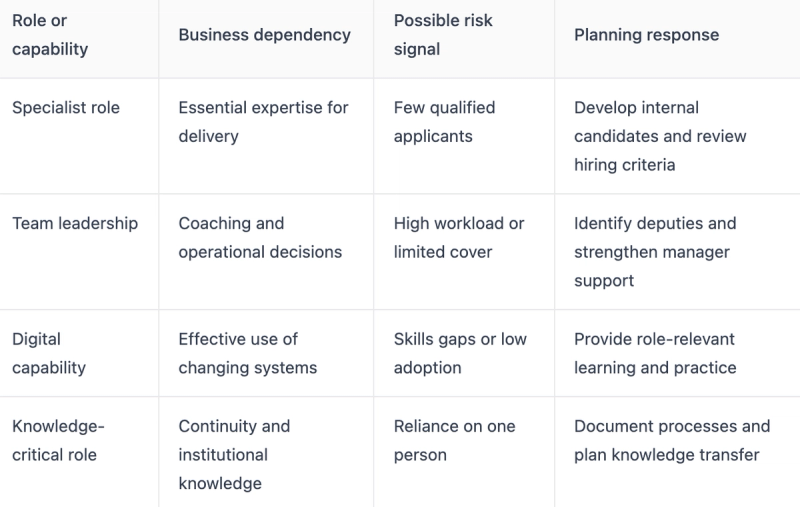
Treat this as a prompt for discussion, not a scoring exercise that predicts the future precisely. Reviewing the table with team leaders can reveal which gaps need recruitment, development or a change in how work is organised.
2. AI and automation move into everyday HR

AI and automation may help HR teams reduce repetitive work, but their value depends on the process and the quality of the information involved. Employers should begin with a specific operational problem rather than adopting a tool simply because it is available. In Hong Kong, as elsewhere, responsible use also means being clear about employee data, accountability and the role of human judgement. Establishing these basics makes it easier to test useful applications without treating automation as a substitute for sound HR practice.
a. Identify HR processes where AI can save time
Start by mapping routine tasks that take time but do not require a nuanced decision, such as organising information or responding to repeated process questions. Then consider whether automation would actually reduce effort without creating new checks or confusion. A small, time-limited pilot can help teams compare the current process with the proposed one. Keep the intended benefit specific, such as reducing manual handling, and assess the result before expanding use.
b. Set clear rules for responsible use of employee data
Employees should know what data is collected, why it is being used and who can access it. HR teams should also establish appropriate access controls, retention practices and a way to correct inaccurate information. These safeguards matter whether a process is automated or handled manually. Regular review of the systems and the data moving between them helps keep privacy and accountability in view.
c. Keep human review in decisions about hiring and performance
Decisions about people can affect livelihoods and career opportunities, so a tool’s output should not be treated as a final judgement. Recruiters and managers need to check whether information is relevant, complete and fair before acting on it. Provide a route for questions or reconsideration when a decision relies on automated assistance. Human review is meaningful only when the reviewer has enough context and authority to challenge an output.
d. Build AI literacy across HR teams and managers
AI literacy need not mean technical expertise for every manager. It does mean understanding what a tool is intended to do, where it may be unreliable and what information should not be entered. Training should use realistic examples from the organisation’s processes and explain how to escalate concerns. A short discussion or learning session can help teams develop shared expectations before new tools become part of routine work.
Use any video or training resource as a starting point for questions, not as a substitute for the organisation’s own policies and review. Managers should be able to explain when a tool is used and what remains a human decision.
3. Skills-based hiring and continuous learning gain ground

A degree or job title can be useful evidence, but it does not always show whether a person can perform the work ahead. Employers can widen their view by identifying the capabilities needed for future priorities and assessing candidates against them. Once those capabilities are clear, hiring and learning become parts of the same workforce plan rather than separate activities. The practical challenge is to make skill requirements specific enough to guide decisions while leaving room for people to develop.
a. Define the capabilities the business will need by 2027
Translate the business plan into capabilities, then distinguish those needed immediately from those that may become more important over time. For each priority, describe how it appears in day-to-day work; broad labels such as “digital” or “leadership” are difficult to recruit and develop against on their own. Involving line managers can expose differences between a skill that sounds important and one that genuinely affects delivery. Revisit the priorities as the business plan changes.
b. Hire for transferable skills as well as qualifications
Transferable skills can help candidates move between roles, particularly when their past job titles do not match the vacancy exactly. Employers can use structured questions, work samples or practical scenarios to understand how someone approaches relevant tasks. Qualifications may remain essential for some work, but should be considered alongside evidence of capability where appropriate. Clear criteria also make it easier for interviewers to compare candidates on a consistent basis.
c. Use internal mobility to fill hard-to-hire roles
Internal candidates may already understand the organisation and bring skills that can be extended through targeted development. To make internal mobility real, publish opportunities clearly, explain selection criteria and discuss transitions with current managers. If internal applicants are repeatedly overlooked because they lack one non-essential requirement, revisit whether that requirement is genuinely necessary. This can open a route to roles that would otherwise depend entirely on external recruitment.
d. Link learning plans to measurable workforce needs
Learning has more value when it addresses a defined skill gap and gives employees a chance to use the skill afterwards. HR and managers can keep the connection visible with a simple sequence of actions:
- Name the capability gap and the work it affects.
- Choose a learning activity suited to the role and starting point.
- Create an opportunity to practise the capability on real work.
- Review progress using evidence relevant to the task.
This sequence avoids treating course attendance as proof that a capability has improved. Review what employees can do after learning and adjust the plan if the business need or the evidence changes.
4. Employee expectations reshape retention strategies

Retention is shaped by daily working conditions as well as formal policies. Employees in different roles may value different forms of flexibility, support and recognition, so a single offer will not necessarily feel equally useful to everyone. Employers can improve their understanding by listening to employees and examining patterns in exit feedback, absence and workload. The aim is to respond to real differences without making inconsistent or unfair decisions.
a. Make flexibility work across different roles and teams
Flexibility can mean different things across an organisation: a change in schedule, location, shift pattern or the way work is shared. Define what is feasible for each role and make the criteria visible, so that employees understand both the available options and their limits. Managers should review arrangements for effectiveness rather than relying on assumptions about who needs flexibility. Consistency does not require identical arrangements; it requires fair, explainable decisions.
b. Treat wellbeing and workload as retention priorities
Wellbeing support is unlikely to compensate for workloads that remain persistently unrealistic. Managers should review capacity, role clarity and the pace of work, then take action where demands are not sustainable. Employers can also make it easier for staff to find appropriate support and explain how confidentiality is handled. Practical employee wellbeing guidance can help HR teams consider support alongside wider benefits and workplace practices.
c. Equip managers to support engagement and development
Managers influence whether employees receive useful feedback, have a voice in decisions and can see a path to develop. Give them guidance for regular conversations about workload, career interests and the support a person needs. These discussions should not become a script; their value comes from listening and following up. Where managers lack time or confidence, training and clear escalation routes can make a difference.
d. Tailor rewards to a multigenerational workforce
A workforce spanning several generations is not a set of fixed preference groups. Employers should avoid designing benefits around stereotypes and instead offer options that respond to different needs, with clear information on eligibility and use. MixCare Health offers Flexible Benefits, a configuration layer in which employees choose their benefit mix from employer-defined options. The practical point for employers is to set relevant choices and review whether the offer works for the people it is intended to support.
5. Employment compliance needs ongoing attention

Compliance is an ongoing management responsibility, not a once-a-year review. Policies, payroll procedures, data practices and workplace decisions all need to reflect current requirements and the organisation’s own circumstances. HR teams can reduce avoidable risk by assigning clear owners to recurring checks and documenting what has changed. Where an issue is complex, seek qualified advice rather than relying on a general article to resolve it.
a. Monitor changes to Hong Kong employment requirements
Set a regular process for checking relevant Hong Kong employment requirements and recording how changes affect internal procedures. Assign responsibility for monitoring, reviewing and communicating updates, so that important information does not depend on one person’s memory. Keep source documents and review dates accessible to the people who administer the relevant processes. This creates a traceable basis for acting when requirements change.
b. Review payroll, leave and termination processes
Payroll, leave and termination processes involve deadlines, records and decisions that should be handled consistently. Periodically walk through each process from the employee’s request or change of status to the final record and communication. Look for unclear hand-offs, missing approvals or dependence on informal workarounds. A documented process makes it easier to spot gaps and to train colleagues who need to carry it out.
c. Protect employee information across HR systems
Employee information may pass between HR, payroll, benefits and other systems. Map what data is held, who can access it and why it needs to be shared; then check that permissions and retention practices remain appropriate. Staff should know how to report a suspected error or exposure, and the organisation should have a clear response process. Privacy controls need attention whenever systems or working practices change.
d. Check that hiring and workplace practices are fair and consistent
Consistency is not achieved by applying the same words mechanically to every situation. It means using relevant criteria, documenting decisions and checking that similar cases receive comparable consideration. Review job descriptions, interview practices, promotion decisions and workplace policies for requirements that cannot be justified by the work. Invite feedback about how processes operate in practice, especially from people who may encounter barriers.
6. HR teams become more data-led and strategic

HR data can help leaders make better decisions, but only when it is accurate, understood and connected to a business question. A long dashboard is not automatically a strategic one; too many measures can obscure the few that need attention. Start with a focused set of indicators and agree what decisions each one is meant to inform. That discipline gives HR a clearer role in discussions about capacity, cost, retention and capability.
a. Choose a focused set of workforce KPIs
Choose measures that relate to the organisation’s priorities, such as vacancy duration for critical roles, internal movement, learning progress or retention in key teams. Define each measure consistently, including its calculation, owner and review frequency. Add context before drawing conclusions: an increase or decrease may have different meanings across teams or periods. A small set of well-understood indicators is easier to act on than a crowded dashboard.
b. Improve the quality and consistency of HR data
Data quality depends on ordinary habits: entering information consistently, correcting errors and agreeing how categories are used. Document definitions for key fields and check for missing or duplicated records before using results in a decision. Where information comes from several systems, identify the authoritative source for each measure. These steps reduce the risk that teams debate numbers that were created using different assumptions.
c. Connect people insights to business decisions
People insights become more useful when they are presented alongside the operational issue they may help explain. For example, compare staffing capacity with delivery needs, or review turnover patterns alongside workload and manager feedback. Avoid claiming that one measure proves a cause; use it to frame questions and decide what further evidence is needed. This makes HR’s contribution more credible and helps business leaders identify practical next steps.
d. Build a practical roadmap for HR technology and change
A technology roadmap should describe the process to improve, the people affected, the controls required and the outcome to review. Sequence changes so teams can learn from early work before introducing more complexity. MixCare Health provides a Flexible Spending Account, a digital employee wallet funded by employers for spending on pre-approved health and wellness categories. For an employer considering benefits administration, that is one documented example of a specific benefits capability; any wider technology plan should still be assessed against the organisation’s requirements, data practices and operating model.
Conclusion
Hong Kong employers can prepare for 2027 by identifying critical roles, supporting skills development and responding to employee needs with fair, practical policies. AI and HR technology may support this work, but clear data practices, human oversight and reliable measures remain essential. A steady cycle of planning, listening and review helps HR teams adapt as business priorities and workforce needs change.
Frequently Asked Questions
What HR trends should Hong Kong employers plan for in 2027?
Employers can prepare for competition for specialist skills, changing workforce needs, responsible use of AI, more skills-based hiring, varied employee expectations and ongoing compliance work.
How can employers identify which roles are most critical?
Connect roles to business priorities, consider the impact of a vacancy or skills gap, and review where knowledge or capacity depends on a small number of people.
How should HR teams introduce AI into their work?
Start with a defined process problem, assess whether automation is appropriate, establish data safeguards and retain human review for decisions that affect employees.
Why is skills-based hiring useful?
It allows employers to assess evidence of relevant capability alongside qualifications, which can help identify candidates whose experience does not match a conventional job-title pathway.
How can organisations improve employee retention?
Review workload, flexibility, manager support and development opportunities, then use employee feedback and workforce information to identify changes that fit different roles.
What should employers include in a workforce plan?
A useful plan links business priorities to roles and capabilities, identifies potential gaps, and sets out whether recruitment, internal development or work redesign is appropriate.
How often should HR compliance processes be reviewed?
Review them on a regular schedule and whenever relevant requirements, systems or working practices change. Assign owners and seek qualified advice for complex questions.
MixCare Health
MixCare Health · Hong Kong