
97% of Hong Kong workers report burnout symptoms — yet only 40% use EAP programmes when available. Here is what the data says about closing the wellbeing gap.
Key Takeaways
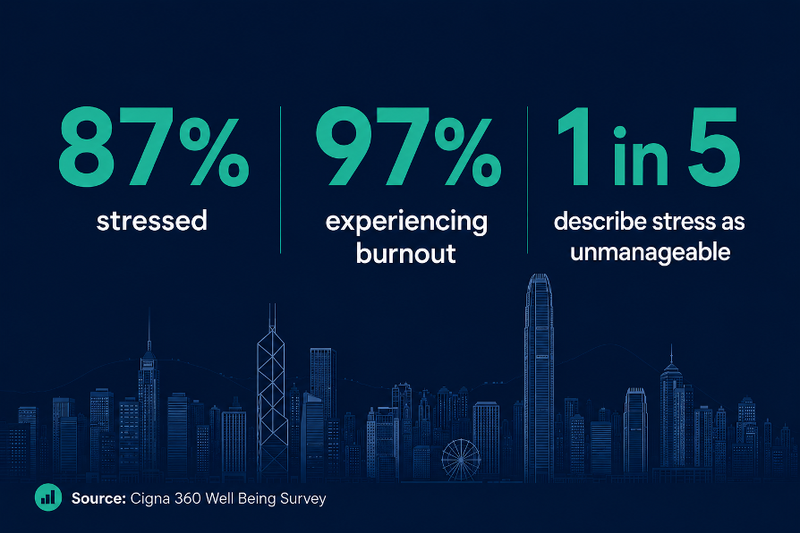
- 87% of Hong Kong workers report stress; 97% report burnout symptoms — 1 in 5 describe their stress as unmanageable (Cigna 360 Well-Being Survey, 2022).
- Only ~40% of stressed employees use EAP programmes even when available (Deloitte). Availability does not equal effectiveness.
- Modern programmes require access to private mental health practitioners, flexible outpatient spend, and manager training.
The WHO estimates a 4:1 return on mental health investment in improved health and productivity. Prevention consistently outperforms crisis response.
Stress rates in Hong Kong have remained persistently high for years. The issue is not awareness. It is the gap between what most organisations provide and what employees actually need.
Hong Kong employees work some of the longest hours of any workforce in the world. The consequences are measurable. According to the Cigna 360 Well-Being Survey, 87% of Hong Kong workers report being ressed, 97% report experiencing burnout symptoms, and 1 in 5 (19%) describe their stress as unmanageable. These figures have remained broadly stable across multiple years of the survey. This is not an anomaly. It is a structural condition inside most large organisations in the city.
Why EAP access is not enough
Most large employers in Hong Kong offer an Employee Assistance Programme. That is a step in the right direction. The problem is utilisation. Research from Deloitte shows that only around 40% of stressed employees use EAP programmes, even when they are available. Employees in acute distress rarely initiate contact with a helpline. They push through, reduce in performance, or eventually leave.
Mental health support is most effective when it is accessible before a crisis, built into the everyday benefits structure, and not dependent on employees recognising and acting on their own distress. An EAP number listed in the employee handbook does not meet that standard.
What a modern wellbeing programme looks like
Closing the gap between provision and effectiveness requires a shift from crisis-response infrastructure to prevention-oriented design. In practice, that means three things:
- Access to private mental health practitioners. Counselling hotlines serve a function, but the clinical need often requires ongoing psychology or psychiatry sessions. Few standard group medical plans cover these without significant out-of-pocket costs, which creates a direct barrier to access.
- Flexible outpatient spend. A wellness allowance or FSA that employees can direct toward mental health services removes the friction of pre-approval and reimbursement processes. It also signals clearly that the employer treats mental health on equal terms with physical health.
- Manager training. The most effective early intervention point is the direct line manager. Training that equips team leads to recognise warning signs, hold supportive conversations, and refer appropriately reduces the time between distress and support significantly.
The commercial case is established
The World Health Organization estimates that for every $1 invested in mental health treatment, there is a $4 return in improved health and productivity. Poor mental health costs employers through absenteeism, presenteeism, and staff turnover — and the organisations that invest in prevention consistently outperform those that manage from crisis to crisis. The business case is no longer speculative.
HR leaders in Hong Kong are operating in a market where talent competition is real, working hours are high, and employee expectations around wellbeing have shifted since 2020. The organisations that treat mental health as a genuine benefits priority will outperform those that treat it as a compliance obligation.
See how MixCare helps organisations close the gap between benefits provision and employee wellbeing. Book a personalised demo to walk through our flexible outpatient, FSA, and wellness programmes — tailored to your workforce.
Every two weeks, the MixCare HR Pulse Digest covers the latest research on workplace wellbeing in Hong Kong and Singapore — with practical guidance for HR leaders.
Sources
Cigna 360 Well-Being Survey · Deloitte: Mental Health at Work · WHO: Investing in Treatment for Depression and Anxiety
MixCare Health
MixCare Health · Hong Kong