
The 2026 World Cup knockout stage is spiking outpatient GP claims. See what your benefits utilisation data reveals now, before your autumn renewal conversations.
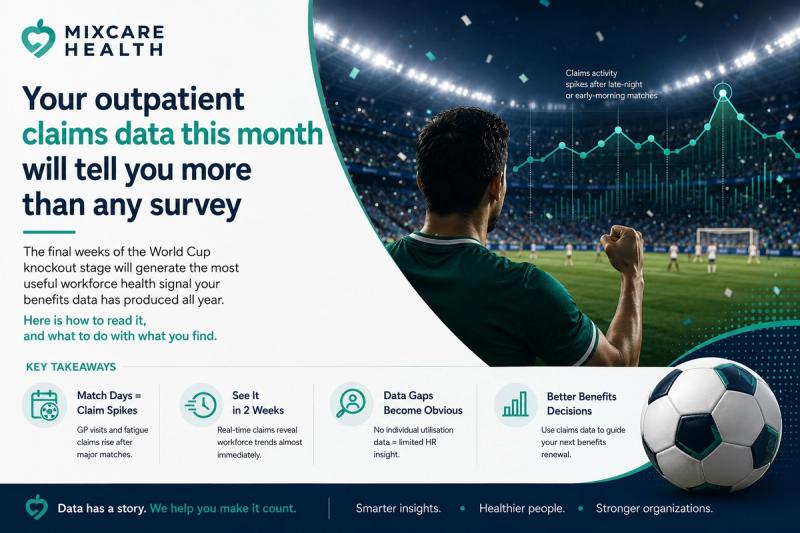
Key Takeaways
- Outpatient claims cluster around match schedules during major tournaments — same-day GP appointments, fatigue-related consultations, and minor illness claims spike consistently on mornings after late-night or early-morning fixtures.
- A 2026 peer-reviewed study of 287,012 participants found a 54 per cent increased risk of influenza diagnosis in the ten days following an acute sleep deprivation event.
- A fourth claims category — gambling-related mental health presentations — surfaces during tournament periods as anxiety GP consultations and EAP referrals. In FY2022/23, HKJC recorded HK$156.9 billion in football betting turnover.
- Real-time spend visibility is not a reporting feature. It is a programme management capability that lets HR teams respond to workforce moments as they happen, not six weeks after the fact.
───────────────────────────────────
When employees are under physiological stress, they visit doctors. When those visits cluster, the data tells you something exact: when it happened, how often, and at what cost. The World Cup knockout stage is one of the sharpest natural experiments in workforce health data that HR teams will see this year — if your platform gives you access to it in time to act.
What the data shows during a tournament period
The pattern across previous major tournaments is consistent. Outpatient claims on mornings following late-night or early-morning matches show a visible spike in three categories: same-day GP consultations attributed to minor illness, fatigue-related appointments covering symptoms including headaches, sleep disruption, and general malaise, and physiotherapy or general recovery visits among employees using flexible spend accounts.
The mechanism is well-documented. A JCI Insight 2026 study analysed electronic health records from 287,012 participants and found a 54 per cent increased risk of influenza diagnosis in the ten days after an acute sleep deprivation event. An earlier UCSF study found that individuals sleeping fewer than five hours were 4.5 times more likely to develop cold symptoms. The baseline in Hong Kong is already compromised: a Cigna 360 Well-Being Survey from 2022 found nine in ten HK workers stressed or burnt out, with 47 per cent of stressed workers reporting disrupted sleep before the tournament began. A ResMed 2026 survey found 72 per cent of Singapore employees have taken sick leave due to poor sleep. The knockout schedule — fixtures falling between 3am and 9am HKT — lands on a workforce already running a sleep deficit. BrightHR data from over one million employees puts the real-world cost in plain terms: 254 per cent surge in sick absences the day after the 2022 World Cup final. A UKG study of 8,000 employees estimates the 2026 tournament will generate USD 17 billion in lost global productivity.
There is a fourth category that claims data may surface during a tournament period, and it is less visible than the other three: gambling-related mental health presentations. In FY2022/23, HKJC recorded **HK$156.9 billion** in football betting turnover — the first year football exceeded horse racing. The Asian Racing Federation estimates Hong Kong's illegal sports betting market at up to USD 2 billion in annual turnover. A 2026 survey of 10,000 Hong Kong residents found 40 per cent know someone who bet with an illegal bookmaker in the past 12 months, and 62 per cent believe those individuals will increase their wagers during this tournament. Problem gambling does not appear in claims as a labelled category. It surfaces as anxiety GP consultations, EAP referrals for financial difficulty, and unexplained mental health specialist referrals in the weeks that follow. The WHO's 2024 gambling disorder fact sheet notes that people with a gambling disorder are 15 times more likely to die by suicide than the general population — a figure that underscores why these presentations should not be treated as routine stress.
What to do with this data
Watch for three signals across July. Spike days: cross-reference same-day GP consultation dates against the knockout match schedule — consistent correlation confirms a tournament response, not an underlying health trend. Category distribution: minor illness and fatigue-adjacent claims rising relative to chronic condition management tells you the cause is situational. EAP alongside outpatient: a simultaneous rise in EAP referrals for financial stress or anxiety during the knockout stage may indicate gambling-related pressure — a connection only visible if your platform surfaces both in real time.
Claims patterns from this period have a second use beyond July. They are direct evidence of which benefits categories your workforce reaches for under pressure — which is when benefits design choices are actually tested. Arrive at your next renewal conversation with four weeks of real utilisation data from a period of elevated demand, rather than a survey asking employees what they think they want.
───────────────────────────────────
MixCare gives HR teams individual-level utilisation data, real-time spend visibility, and flexible category configuration. Book a personalised demo to see how the reporting works.
MixCare Health
MixCare Health · Hong Kong