Your flexible employee benefits programme in Hong Kong and Singapore isn't underused because employees don't care. It's underused because it wasn't designed for how people actually live and work.
Key Takeaways

- Low utilisation is a design failure: when benefits are built around a fictional average employee, they fail the majority of the workforce they are meant to serve.
- Workforce segments have incompatible priorities, so a single fixed package will always leave younger employees, parents and senior staff underserved at the same time.
- FSA and wellness wallet structures consistently outperform traditional entitlements because employees allocate spend to what they actually need, and employers retain a predictable cost ceiling.
- Four design principles drive measurable uptake: structured choice, frictionless access, employee-facing transparency, and employer-side utilisation data.
- APAC medical inflation reached 11.3% in 2026, the only region forecast to rise year-on-year (Aon), which means the cost of low utilisation is compounding faster here than anywhere else.
- The CFO case rests on four numbers: utilisation by category, cost per engaged employee, year-on-year cost movement, and the impact on employee turnover.
Benefits budgets in Hong Kong and Singapore have never been larger. Yet the gap between what employers spend and what employees value remains the defining challenge for total rewards leaders this year.
This article gives you a practical framework for closing it: why utilisation fails, what APAC employees actually want, how to design for engagement, which benefit structures outperform traditional entitlements, and what your CFO needs to see.
The utilisation gap: why employees ignore benefits they are entitled to
The utilisation gap is a design problem, not a communication problem. Most benefits programmes in Hong Kong and Singapore were built for a workforce that no longer exists: full-time, office-based, and accustomed to annual entitlements defined by HR without employee input.
Today's APAC workforce is multi-generational, hybrid, and under genuine financial pressure. When a benefits package offers dental cover an employee cannot schedule due to overtime, or a gym membership inaccessible to remote workers, the entitlement sits unclaimed. The benefit does not fit the life the employee is actually living.
Without individual-level utilisation data, HR teams cannot identify which benefits are underperforming, which employee segments are disengaged, or where budget is being absorbed without return.
What APAC-specific research tells us about benefits preferences by workforce segment
No single benefit works for every employee. Workforce segment is the more useful unit of analysis than headcount.
Younger employees (mid-20s to early 30s) prioritise mental health support, preventive care, and financial wellbeing tools. Tangible, near-term value over hypothetical future cover. Mobile-first expectations are high: if a benefit requires a paper form during business hours, it will go unused.
Mid-career employees withdependants place greater weight on outpatient flexibility and family cover. In Hong Kong and Singapore, where out-of-pocket healthcare costs for dependants are significant, benefits that extend meaningfully to family members directly influence retention decisions.
Senior and specialist employees are more likely to value executive health screening, mental health resources, and financial planning access. Personalisation signals that the organisation sees them as individuals.
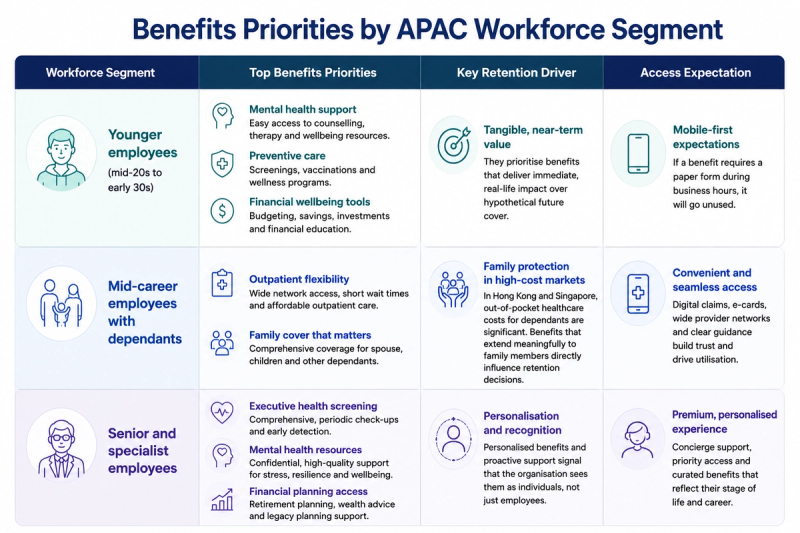
A one-size entitlement structure will satisfy none of these segments well. A modular, employee-directed programme consistently outperforms fixed-schedule approaches on both utilisation and employee satisfaction.
The four design principles of benefits programmes with high engagement rates
Choice withinstructure. A curated marketplace of 15 to 20 benefit categories outperforms both a rigid fixed schedule and an open-ended allowance. Structure reduces decision fatigue; choice drives relevance.
Frictionless access. Benefits requiring paper claims or panel clinic constraints see materially lower utilisation. In Hong Kong and Singapore, where smartphone penetration is near-universal, there is no justification for analogue claims processes.
Transparency for the employee. When employees can see their remaining balance and full range of available options, they use their benefits more. Visibility creates engagement. Opacity creates inertia.
Employer-side data. Real-time utilisation dashboards let HR teams see what is working, identify underserved segments, and make evidence-based adjustments rather than relying on assumptions that grow more outdated each year.
FSA and wellness wallets: why spending-led benefits outperform traditional entitlements
A traditional entitlement gives an employee access to a fixed benefit: a specific panel clinic, a defined dental limit, a set number of physiotherapy sessions. There is no agency, and the structure rarely matches individual circumstances.
A Flexible Spending Account (FSA) or wellness wallet allocates a defined annual budget per employee, directed across approved categories: outpatient care, mental health sessions, fitness, vision care, or family health. The employer sets the overall budget and eligible categories; the employee controls the allocation.
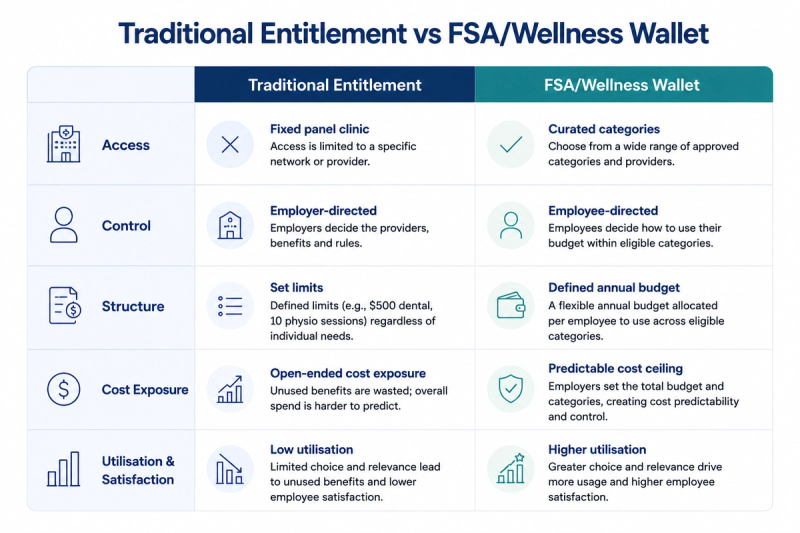
APAC medical inflation reached 11.3% in 2026, the only region forecast to increase year-on-year and significantly above the global average of 9.8% (Aon 2026 Global Medical Trend Rates Report). An FSA structure gives employers a predictable cost ceiling per employee while giving employees the flexibility to direct that budget where it matters most. It is one of the few benefits structures that simultaneously improves cost management for the employer and perceived value for the employee.
Measuring what matters: the data HR leaders need to report to their CFO
CFOs need to see cost efficiency, not just engagement metrics. Four measures carry weight in that conversation: utilisation rate by benefit category; cost per engaged employee; year-on-year cost movement against a fixed-budget baseline; and voluntary turnover rates before and after programme redesign.
Most HR teams are reporting aggregate spend, without the category-level breakdown that makes data actionable. Aggregate numbers do not identify which benefits are driving engagement and which are absorbing budget without return.
According to SHRM's The Human + AI Advantage, 89% of organisations using AI in HR report greater operational efficiency. Benefits data reporting is one of the highest-friction tasks that platform automation can eliminate.
When HR leaders can present a dashboard showing utilisation by cohort, budget variance, and a utilisation-to-retention correlation, the conversation shifts from cost justification to investment management.
MixCare Health gives HR teams in Hong Kong and Singapore real-time spend visibility and individual-level utilisation data, alongside a modular, APAC-native benefits platform built to drive the utilisation rates that make the data worth reporting.
Ready to see what a flexible benefits programme looks like in practice?
MixCare Health works with HR leaders at enterprise organisations across Hong Kong and Singapore, with individual-level utilisation data, real-time spend visibility, and full PDPO and ISO 27001 compliance built in. No commitment required.
If you like this content, subscribe to our HR Pulse Digest for the latest APAC benefits benchmarks.
Frequently Asked Questions
What is a flexible employee benefits programme in Hong Kong and Singapore?
A flexible employee benefits programme gives employees a defined annual budget or a set of modular benefit options they can direct according to their personal circumstances, rather than a fixed entitlement schedule set entirely by the employer. In Hong Kong and Singapore, flexible programmes typically include outpatient care, mental health support, wellness services, and family health options, with employees choosing how to allocate their benefit budget across approved categories.
Why is employee benefits utilisation low in APAC?
Low benefits utilisation in APAC is most commonly caused by poor benefit-to-employee fit, high access friction (paper claims, panel clinic constraints, slow reimbursement), and limited employee visibility into what they are entitled to and how to use it. This is a design problem, not a communication one.
How does an FSA or wellness wallet work for APAC employers?
A Flexible Spending Account or wellness wallet allocates a defined annual budget per employee, which they can direct across a curated set of approved benefit categories: outpatient care, mental health, fitness, family health, and more. The employer sets the total budget and eligible categories; the employee controls the allocation. This structure consistently generates higher utilisation rates and better employee satisfaction scores than fixed-entitlement approaches, while giving employers a predictable, defined cost ceiling per employee.
What benefits utilisation data should HR leaders report to their CFO?
The four measures with the most impact in a CFO conversation are: utilisation rate by benefit category; cost per engaged employee; year-on-year cost movement against a fixed-budget baseline; and voluntary turnover rates before and after benefits programme redesign. Real-time, individual-level utilisation data is the foundation for all four measures. Aggregate spend data alone is not sufficient for an evidence-based benefits investment case.
How does APAC medical inflation affect flexible benefits programme design?
APAC medical inflation reached 11.3% in 2026, the only region forecast to increase year-on-year and significantly above the global average of 9.8% (Aon 2026 Global Medical Trend Rates Report). Flexible benefits structures give employers a defined, controllable cost ceiling per employee rather than absorbing open-ended premium inflation.
Is a flexible benefits programme in Hong Kong compliant with PDPO requirements?
Yes, when managed through a compliant platform. Because a flexible benefits programme involves the employer accessing individual-level employee health and spend data, the platform must be certified under Hong Kong's Personal Data Privacy Ordinance (PDPO) and, for enterprise deployments, ISO 27001. Employers should confirm both certifications, plus independent annual security testing, with any platform they evaluate. MixCare Health holds both certifications and undergoes annual independent security testing.
MixCare Health
MixCare Health · Hong Kong